
Original: $350.00
-70%$350.00
$105.00The Story
Original Item. Only One Available. When it comes to designing a training program for military personnel, instructors are faced with several challenges. First, unlike athletes there is no off-season, most units are either preparing for deployment, deployed, or refitting from deployment. Secondly, training facilities vary from location to location and often focus on a single task. These tasks may include muscular strength, cardiovascular endurance, field craft or marksmanship. Each of the above contribute to the success of an operation, however there is one area of training that is deficient. This deficiency is visual training; visual ability plays a larger role in achieving optimum performance than most military personnel realize. The goal of integrating visual training into an already packed curriculum is not to dilute it but to improve tactical performance.
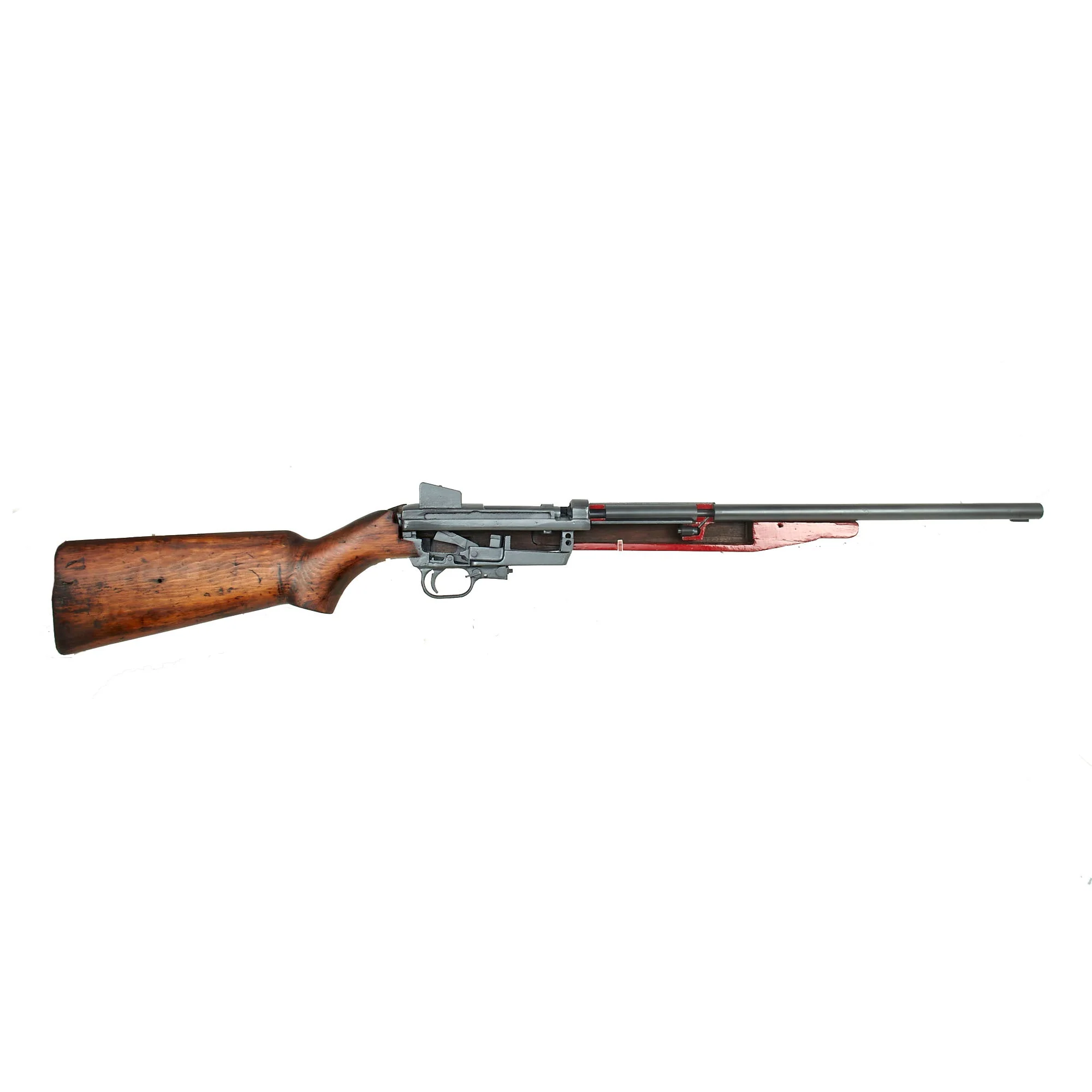
To help users better understand the equipment they are using, examples like this cutaway were made. These were intended to give the users a look at the internal structure of the explosives, showing the different layers as well as where they connect or thread into each other.
Unloaded or dummy grenades, artillery shell casings, and similar devices, which are cut or drilled in an BATF-approved manner so that they cannot be used as ammunition components for destructive devices, are not considered NFA weapons. This example is in total compliance and is NOT AVAILABLE FOR EXPORT.
This is a great Vietnam War era cutaway M564 fuze for a mortar. This is the U.S. M564, a High-Explosive (HE), Mechanical-Time-Super-Quick (MTSQ), projectile fuze used with 105mm, 155mm and 203mm (8") projectiles or Mortar-Bombs when a choice between time and Super-Quick (SQ) action is desired, consisting of a head, cap, body and Delay (DLY) arming-mechanism.
The M564 was produced during the late 1960's and early 70's for 105mm, 155mm and 8in. projectiles. It has a 2-100sec selectable delay with a Point Detonating back-up. There is a safety at the nose and a delay arming mechanism (DAM) at the bottom, which aligns the detonator with the booster only after the shell has traveled a safe distance (200 ft from the muzzle). The timer is powered by an internal main spring. The safety adapter (lower timer) is powered by centrifugal force generated by the spinning projectile. This fuze was likely manufactured by Hamilton Watch Company, who produced about 20 million of them at a cost of about $15.50 each (1970 dollars).
The fuze measures roughly 6” tall. The name R.P. BITZER is scratched into the bottom. A great cutaway, ready for further research and display.

Details & Craftsmanship
Every detail has been carefully considered to bring you the perfect product.

Details & Craftsmanship
Every detail has been carefully considered to bring you the perfect product.

Details & Craftsmanship
Every detail has been carefully considered to bring you the perfect product.

Details & Craftsmanship
Every detail has been carefully considered to bring you the perfect product.

Details & Craftsmanship
Every detail has been carefully considered to bring you the perfect product.
Description
Original Item. Only One Available. When it comes to designing a training program for military personnel, instructors are faced with several challenges. First, unlike athletes there is no off-season, most units are either preparing for deployment, deployed, or refitting from deployment. Secondly, training facilities vary from location to location and often focus on a single task. These tasks may include muscular strength, cardiovascular endurance, field craft or marksmanship. Each of the above contribute to the success of an operation, however there is one area of training that is deficient. This deficiency is visual training; visual ability plays a larger role in achieving optimum performance than most military personnel realize. The goal of integrating visual training into an already packed curriculum is not to dilute it but to improve tactical performance.
To help users better understand the equipment they are using, examples like this cutaway were made. These were intended to give the users a look at the internal structure of the explosives, showing the different layers as well as where they connect or thread into each other.
Unloaded or dummy grenades, artillery shell casings, and similar devices, which are cut or drilled in an BATF-approved manner so that they cannot be used as ammunition components for destructive devices, are not considered NFA weapons. This example is in total compliance and is NOT AVAILABLE FOR EXPORT.
This is a great Vietnam War era cutaway M564 fuze for a mortar. This is the U.S. M564, a High-Explosive (HE), Mechanical-Time-Super-Quick (MTSQ), projectile fuze used with 105mm, 155mm and 203mm (8") projectiles or Mortar-Bombs when a choice between time and Super-Quick (SQ) action is desired, consisting of a head, cap, body and Delay (DLY) arming-mechanism.
The M564 was produced during the late 1960's and early 70's for 105mm, 155mm and 8in. projectiles. It has a 2-100sec selectable delay with a Point Detonating back-up. There is a safety at the nose and a delay arming mechanism (DAM) at the bottom, which aligns the detonator with the booster only after the shell has traveled a safe distance (200 ft from the muzzle). The timer is powered by an internal main spring. The safety adapter (lower timer) is powered by centrifugal force generated by the spinning projectile. This fuze was likely manufactured by Hamilton Watch Company, who produced about 20 million of them at a cost of about $15.50 each (1970 dollars).
The fuze measures roughly 6” tall. The name R.P. BITZER is scratched into the bottom. A great cutaway, ready for further research and display.