
The Story
Original Item: Only One Available. Totally inert and demilitarized according to BATF guidelines with hollow body and inert fuse. This grenade cannot be converted to an explosive device and is not available for export.
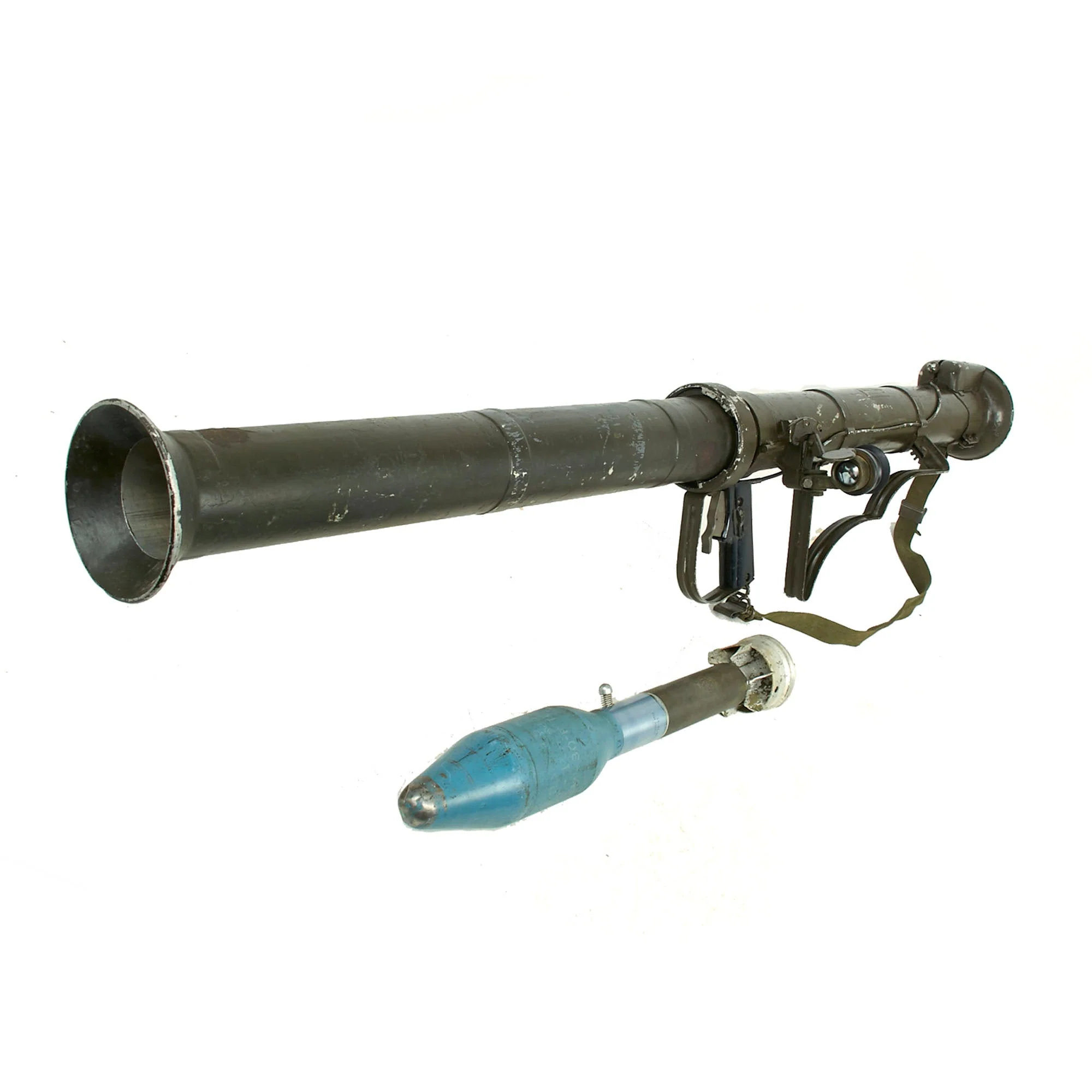
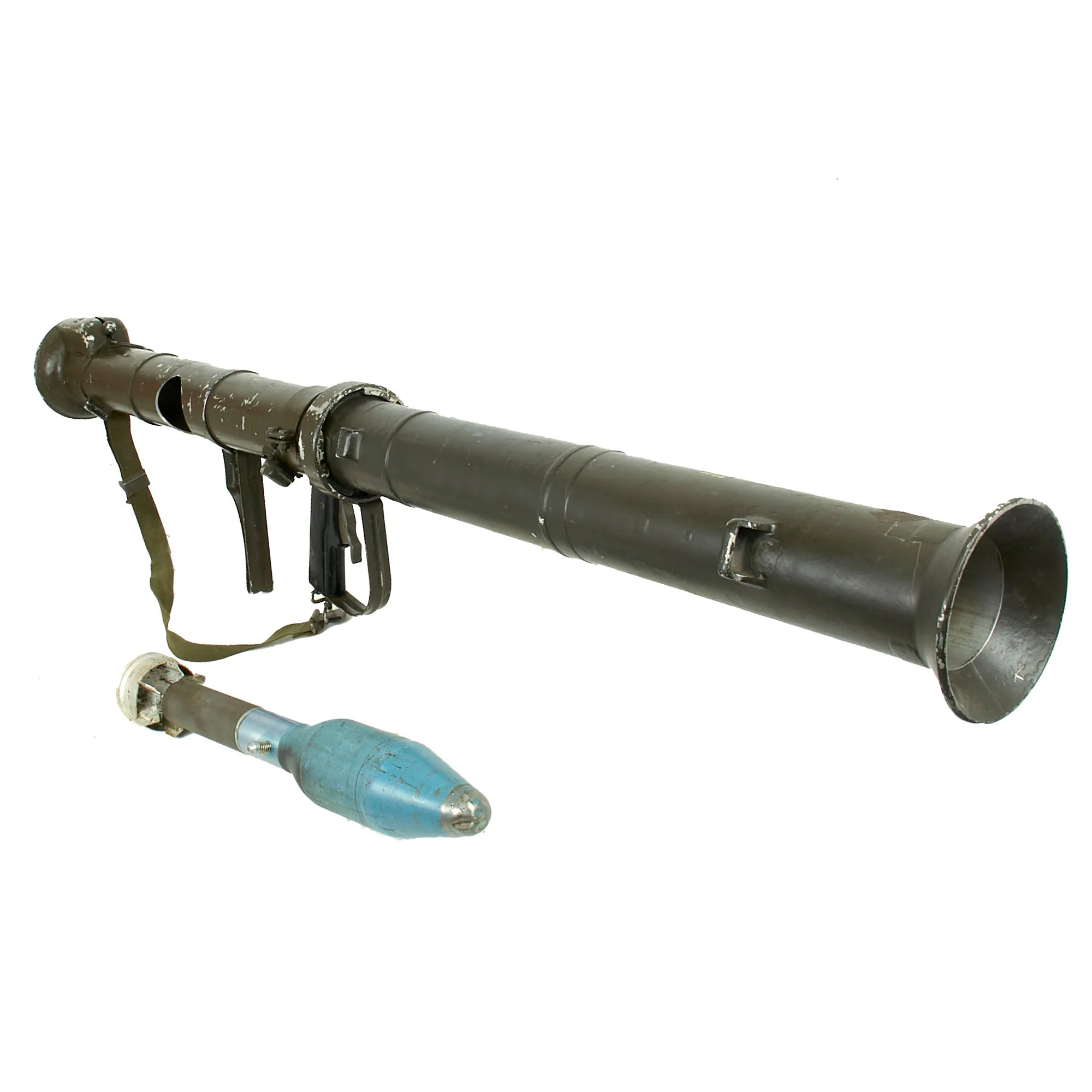
This is a replica WWII Mk. II grenade which has an original M10A2 fuze jammed into the threading with tape, attached to a great 1944-dated Rifle Grenade Adapter, marked on the side in yellow paint stampings:
ADAPTER, GRENADE
PROJECTION, M1
J.J.N.-15
1944
Also included is an M7 Grenade Launcher/thrower attachment for the M1 Garand. This attachment is offered in good condition with little surface rust. The markings on the M7 are:
FAY & SCOTT
M7 GRENADE LAUNCHER
FOR M1 RIFLE
The replica grenade has an original M10A2 fuze jammed into the threading using tape, and is marked:
FUZE M10A2
F.L.I. LOT
36-23144-45
A good launcher and adapter with a replica grenade, ready for display.
The Mk 2 grenade (initially known as the Mk II) is a fragmentation type anti-personnel hand grenade introduced by the U.S. armed forces in 1918. It was the standard issue anti-personnel grenade used during World War II, and also saw limited service in later conflicts, including the Korean War and Vietnam War. Replacing the failed Mk 1 grenade of 1917, it was standardized in 1920 as the Mk II, and redesignated the Mk 2 on April 2, 1945.
The Mk 2 was gradually phased out of service as the M26-series (M26/M61/M57) grenade was introduced during the Korean War. Due to the tremendous quantity manufactured during World War II the Mk 2 was still in limited use with the US Army and US Marine Corps throughout the 1950s and 1960s. The U.S. Navy was one of the last users of the Mk 2 when it was finally withdrawn from U.S. military service in 1969, replaced with the M33 series (M33/M67).
The M7 grenade launcher, formally rifle grenade launcher, M7, was a 22 mm rifle grenade launcher attachment for the M1 Garand rifle that saw widespread use throughout World War II and the Korean War. The M7 was a tube-shaped device, with one end slotting over the muzzle of the rifle and attaching to the bayonet mount, and the other end holding the grenade in place. Blank cartridges were loaded into the rifle prior to firing. When fired, the expanding gases generated by the cartridges propelled the grenade forward with considerable force. The M7 could fire grenades up to 200 metres (220 yards), compared with the maximum of 30 metres (33 yards) achieved by a hand-thrown grenade.
Anti-armor (M9), Fragmentation (M17), and smoke grenades (M22) were available for the M7.
The M1 grenade projection adapter was an expedient rifle grenade used by the American military in World War II, Korea, and Vietnam. It consisted of an add-on 22 mm stabilizer tube and fins that converted a hand-grenade into a rifle grenade. It supplanted the M17 rifle grenade, and was eventually made obsolete by the 40mm M79 grenade launcher.
The M1 grenade projection adapter was designed to easily convert standard Mk 2 hand grenades into rifle grenades. This was done by inserting a Mk 2 grenade into the prongs while a holder on one of the prongs kept the arming lever from releasing. The unit was then placed on the 22 mm M7 grenade launcher attached to the M1 rifle's muzzle. The user then removed the grenade's safety pin and braced the rifle from a standing or kneeling position. The unit was launched by firing a high-powered blank from the rifle. Inertia caused the holder to shear off in flight, releasing the lever and arming the grenade. The grenade would then explode when its fuze ran out.
Although somewhat clumsy in appearance and operation, the M1 grenade projection adapter was well liked by the troops, who more often than not preferred it to the earlier M17 rifle grenade. The M17 would often fail to detonate if it impacted on sand, water or mud; only solid ground would cause it to detonate.

Details & Craftsmanship
Every detail has been carefully considered to bring you the perfect product.

Details & Craftsmanship
Every detail has been carefully considered to bring you the perfect product.

Details & Craftsmanship
Every detail has been carefully considered to bring you the perfect product.

Details & Craftsmanship
Every detail has been carefully considered to bring you the perfect product.

Details & Craftsmanship
Every detail has been carefully considered to bring you the perfect product.
Description
Original Item: Only One Available. Totally inert and demilitarized according to BATF guidelines with hollow body and inert fuse. This grenade cannot be converted to an explosive device and is not available for export.
This is a replica WWII Mk. II grenade which has an original M10A2 fuze jammed into the threading with tape, attached to a great 1944-dated Rifle Grenade Adapter, marked on the side in yellow paint stampings:
ADAPTER, GRENADE
PROJECTION, M1
J.J.N.-15
1944
Also included is an M7 Grenade Launcher/thrower attachment for the M1 Garand. This attachment is offered in good condition with little surface rust. The markings on the M7 are:
FAY & SCOTT
M7 GRENADE LAUNCHER
FOR M1 RIFLE
The replica grenade has an original M10A2 fuze jammed into the threading using tape, and is marked:
FUZE M10A2
F.L.I. LOT
36-23144-45
A good launcher and adapter with a replica grenade, ready for display.
The Mk 2 grenade (initially known as the Mk II) is a fragmentation type anti-personnel hand grenade introduced by the U.S. armed forces in 1918. It was the standard issue anti-personnel grenade used during World War II, and also saw limited service in later conflicts, including the Korean War and Vietnam War. Replacing the failed Mk 1 grenade of 1917, it was standardized in 1920 as the Mk II, and redesignated the Mk 2 on April 2, 1945.
The Mk 2 was gradually phased out of service as the M26-series (M26/M61/M57) grenade was introduced during the Korean War. Due to the tremendous quantity manufactured during World War II the Mk 2 was still in limited use with the US Army and US Marine Corps throughout the 1950s and 1960s. The U.S. Navy was one of the last users of the Mk 2 when it was finally withdrawn from U.S. military service in 1969, replaced with the M33 series (M33/M67).
The M7 grenade launcher, formally rifle grenade launcher, M7, was a 22 mm rifle grenade launcher attachment for the M1 Garand rifle that saw widespread use throughout World War II and the Korean War. The M7 was a tube-shaped device, with one end slotting over the muzzle of the rifle and attaching to the bayonet mount, and the other end holding the grenade in place. Blank cartridges were loaded into the rifle prior to firing. When fired, the expanding gases generated by the cartridges propelled the grenade forward with considerable force. The M7 could fire grenades up to 200 metres (220 yards), compared with the maximum of 30 metres (33 yards) achieved by a hand-thrown grenade.
Anti-armor (M9), Fragmentation (M17), and smoke grenades (M22) were available for the M7.
The M1 grenade projection adapter was an expedient rifle grenade used by the American military in World War II, Korea, and Vietnam. It consisted of an add-on 22 mm stabilizer tube and fins that converted a hand-grenade into a rifle grenade. It supplanted the M17 rifle grenade, and was eventually made obsolete by the 40mm M79 grenade launcher.
The M1 grenade projection adapter was designed to easily convert standard Mk 2 hand grenades into rifle grenades. This was done by inserting a Mk 2 grenade into the prongs while a holder on one of the prongs kept the arming lever from releasing. The unit was then placed on the 22 mm M7 grenade launcher attached to the M1 rifle's muzzle. The user then removed the grenade's safety pin and braced the rifle from a standing or kneeling position. The unit was launched by firing a high-powered blank from the rifle. Inertia caused the holder to shear off in flight, releasing the lever and arming the grenade. The grenade would then explode when its fuze ran out.
Although somewhat clumsy in appearance and operation, the M1 grenade projection adapter was well liked by the troops, who more often than not preferred it to the earlier M17 rifle grenade. The M17 would often fail to detonate if it impacted on sand, water or mud; only solid ground would cause it to detonate.