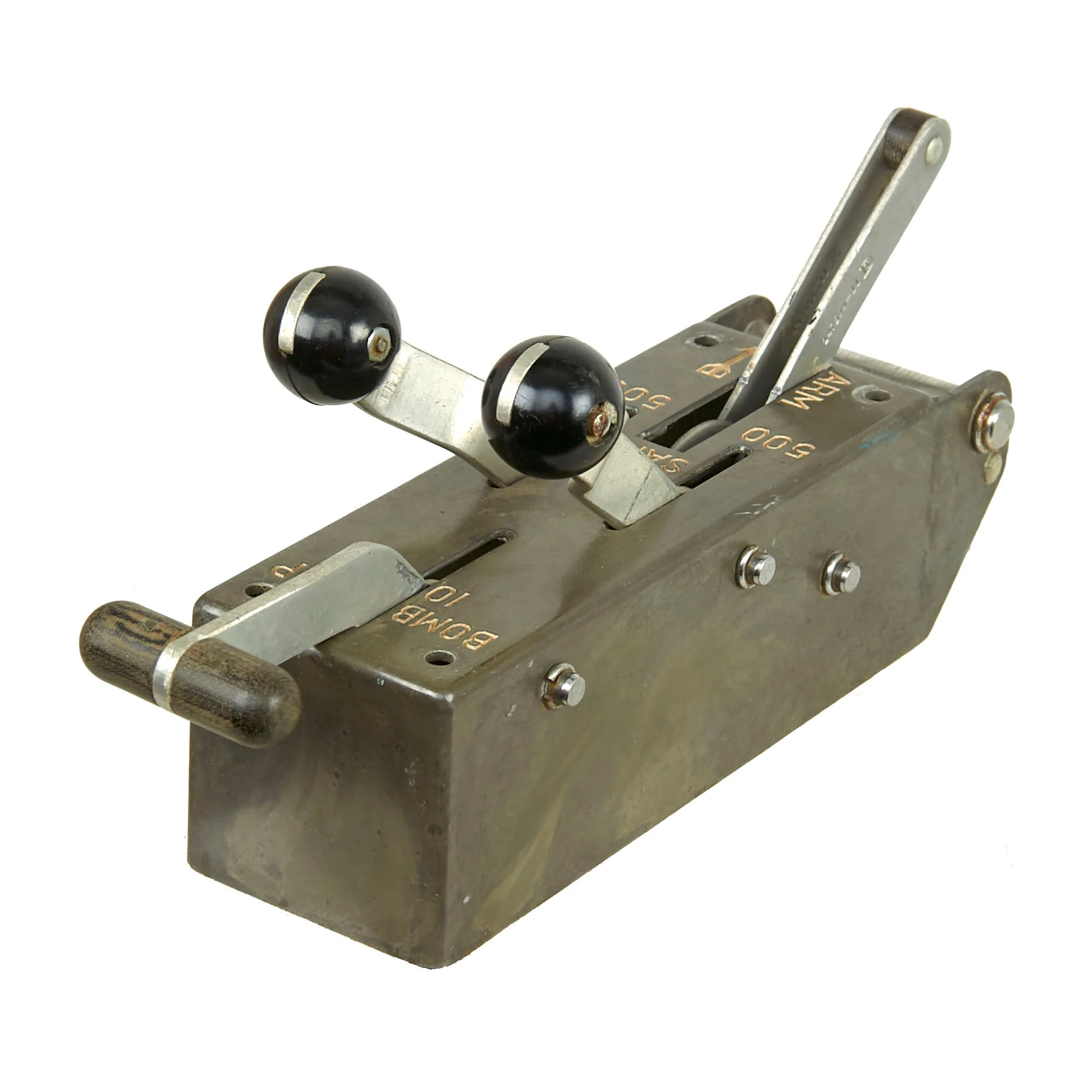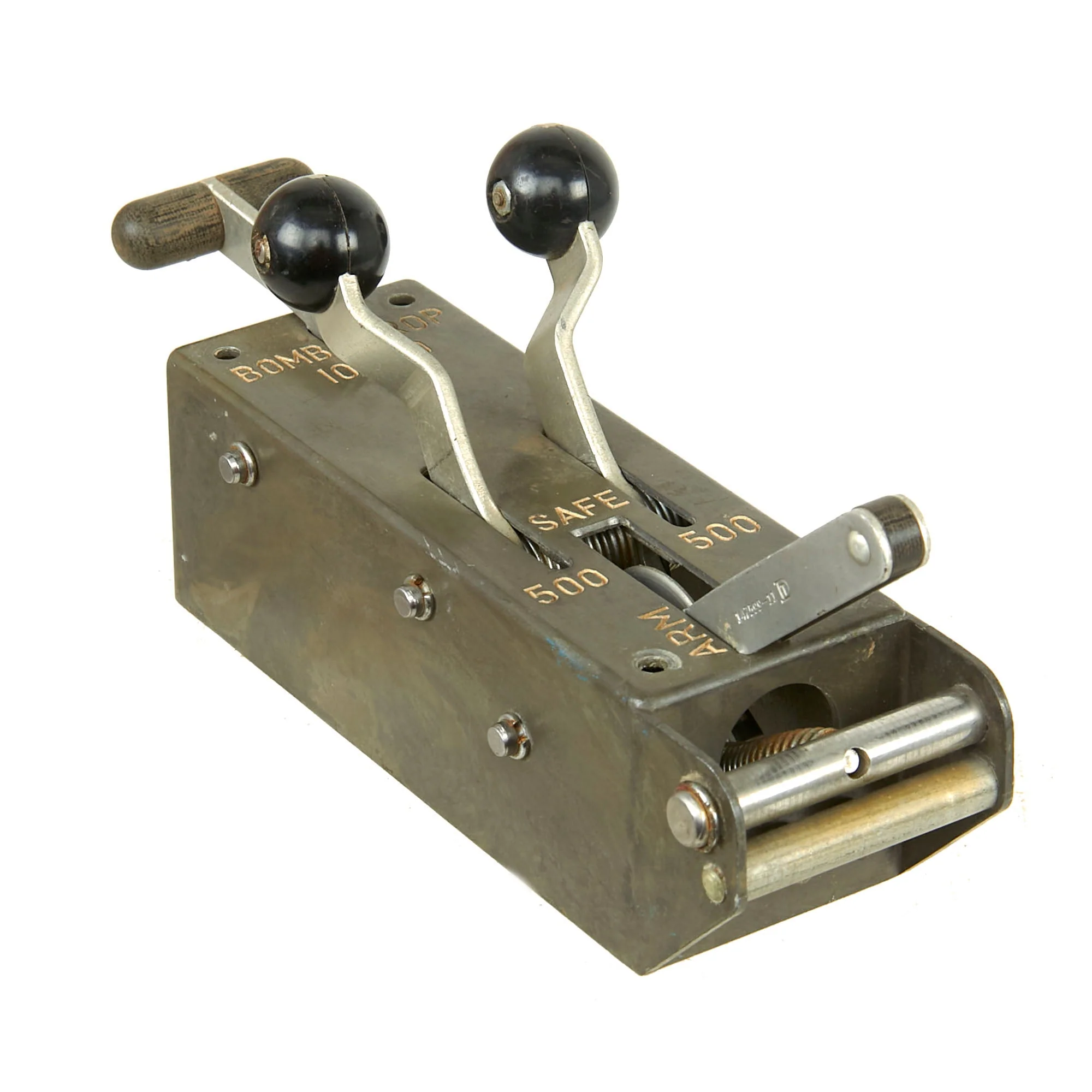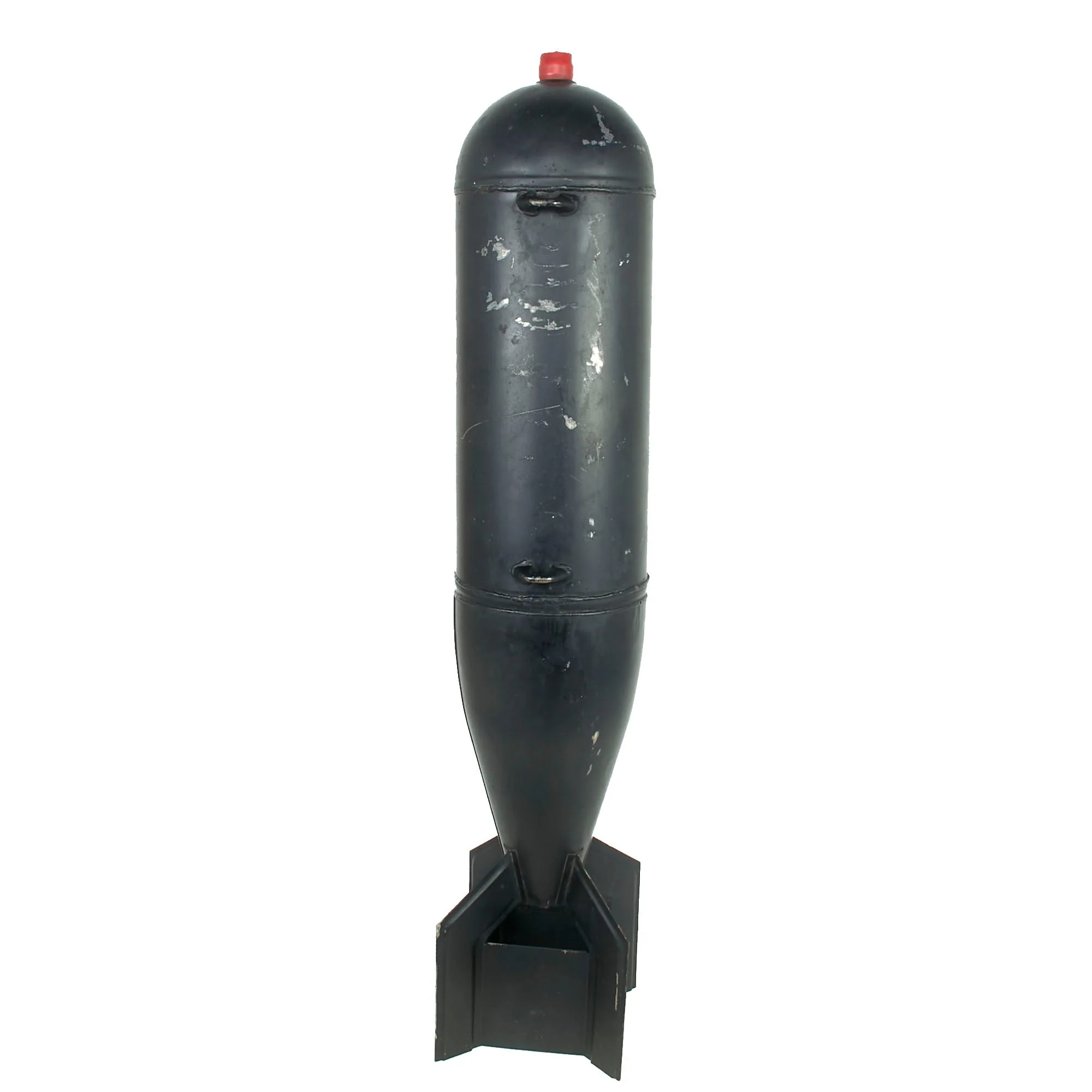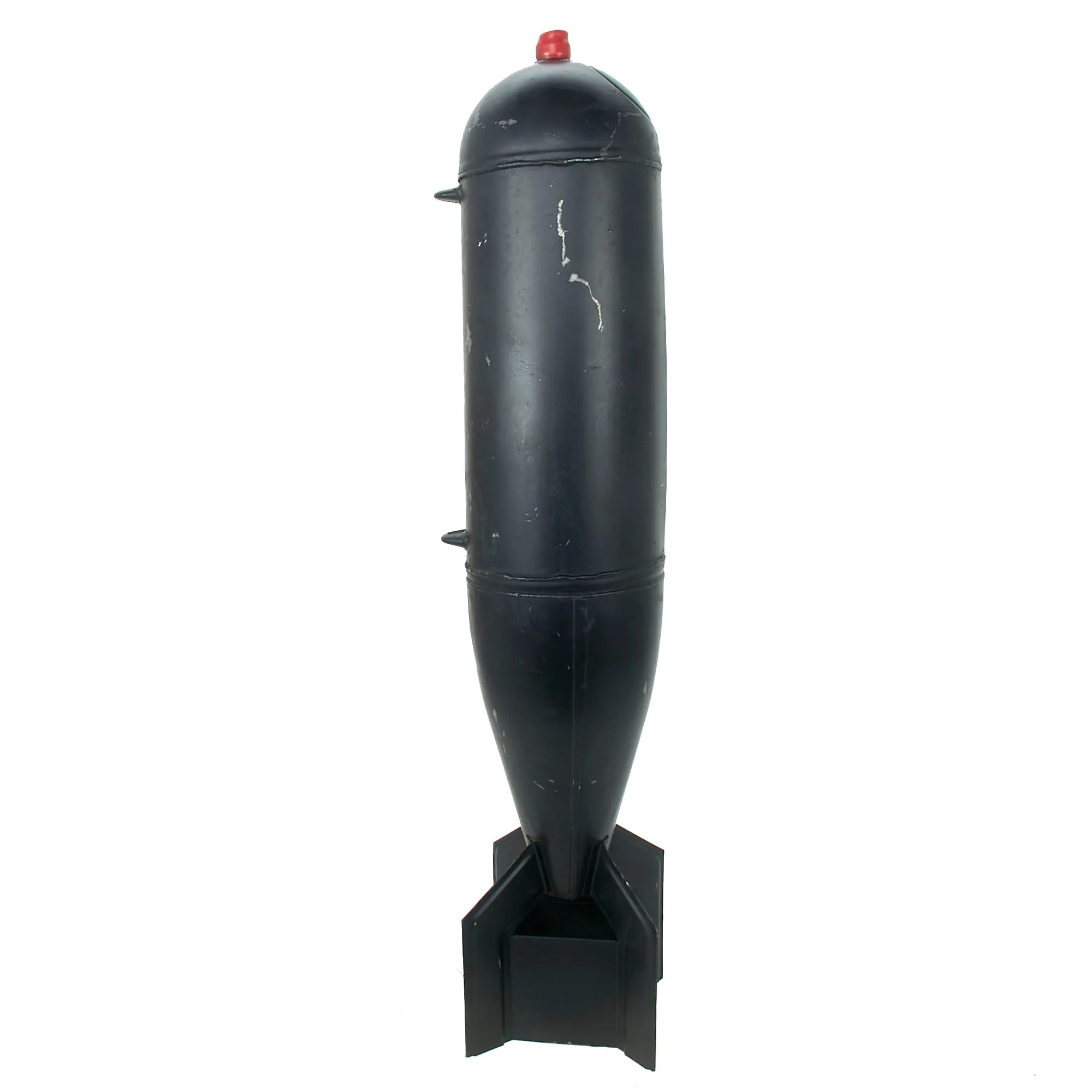

Original U.S. WWII M21 Inert Practice Pineapple Fragmentation Training Hand Grenade with Early Cutback M10 Fuze and Original Correct Husk - Dated 1939
Original U.S. WWII M21 Inert Practice Pineapple Fragmentation Training Hand Grenade with Early Cutback M10 Fuze and Original Correct Husk - Dated 1939
Original: $595.00
-70%$595.00
$178.50The Story
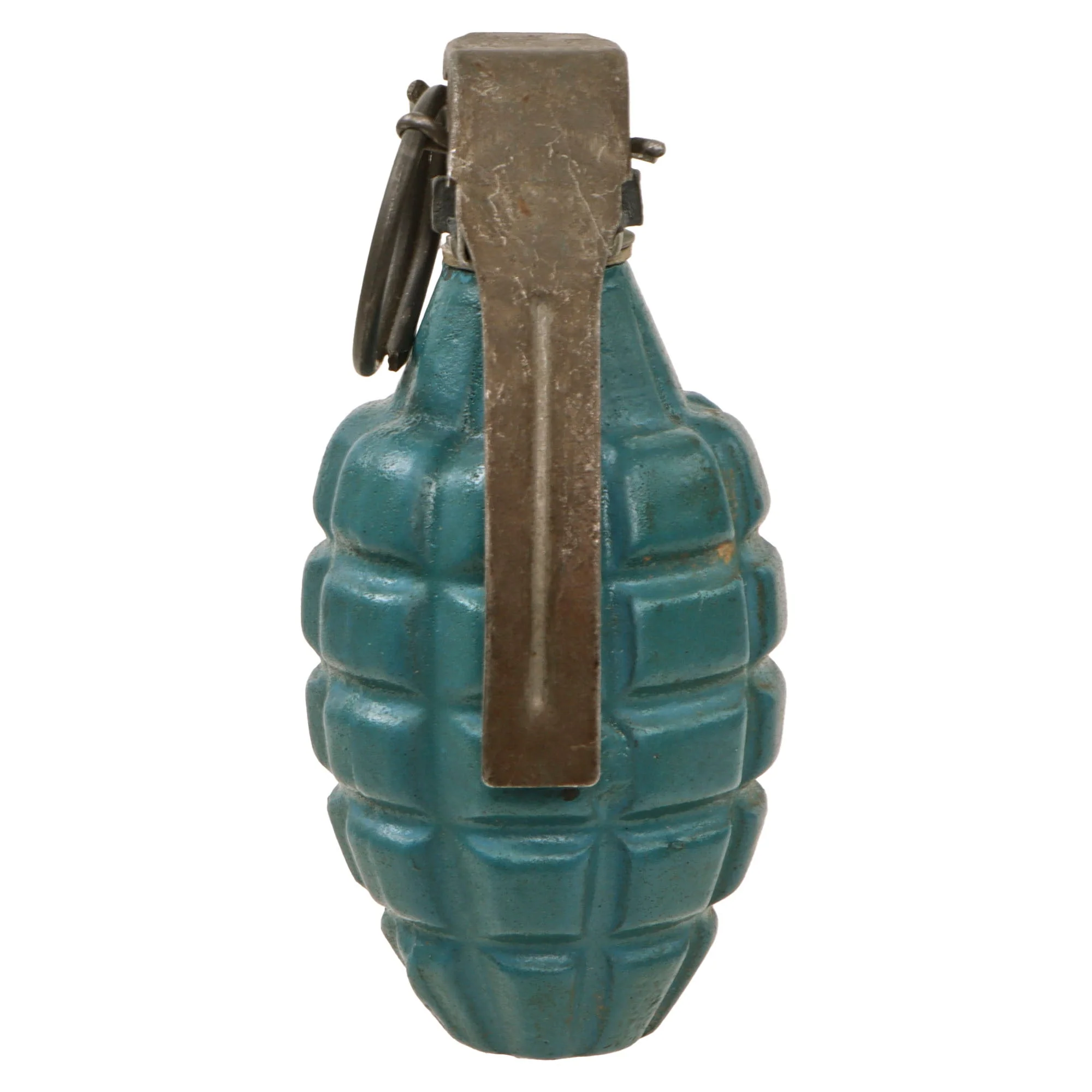
Original Item: Only One Available. Totally inert according to BATF guidelines with a hollow body and inert fuse. This is a great example of the M21 Practice Training grenade, an inert version of the iconic U.S. fragmentation pineapple grenade issued during WWII. The Mk II was standardized in 1920 replacing the Mk I of 1917. It was phased out gradually, the U.S. Navy being the last users, and on 2 April 1945 the Mk II and Mk IIA1 were re-designated the Mk 2 and Mk 2A1.
The Mk II was commonly known as a pineapple grenade, because of its shape and structure. Grooves were cast into the cast iron shell, which was believed at the time to aid in fragmentation and had the side benefit of aiding in gripping the grenade: this provision gave it the appearance of a pineapple fruit. The Mk II was identified with an all yellow body prior to 1943. They were then painted olive drab for camouflage purposes with a narrow yellow band below the fuse. There are numerous variations in the fragment and groove details that can be found, which seems to depend on the particular manufacturer.
This very nice WWII issue training grenade retains mostly all of the correct blue paint. This example is an early Circa 1939 tapered body example. It comes with an original early M10 cutback fuze and in its original correct husk. It is offered in very good condition. It has an open hollow end, as most practice grenades usually did.
Unloaded or dummy grenades, artillery shell casings, and similar devices, which are cut or drilled in an BATF-approved manner so that they cannot be used as ammunition components for destructive devices, are not considered NFA weapons. This example is in total compliance and is NOT AVAILABLE FOR EXPORT.
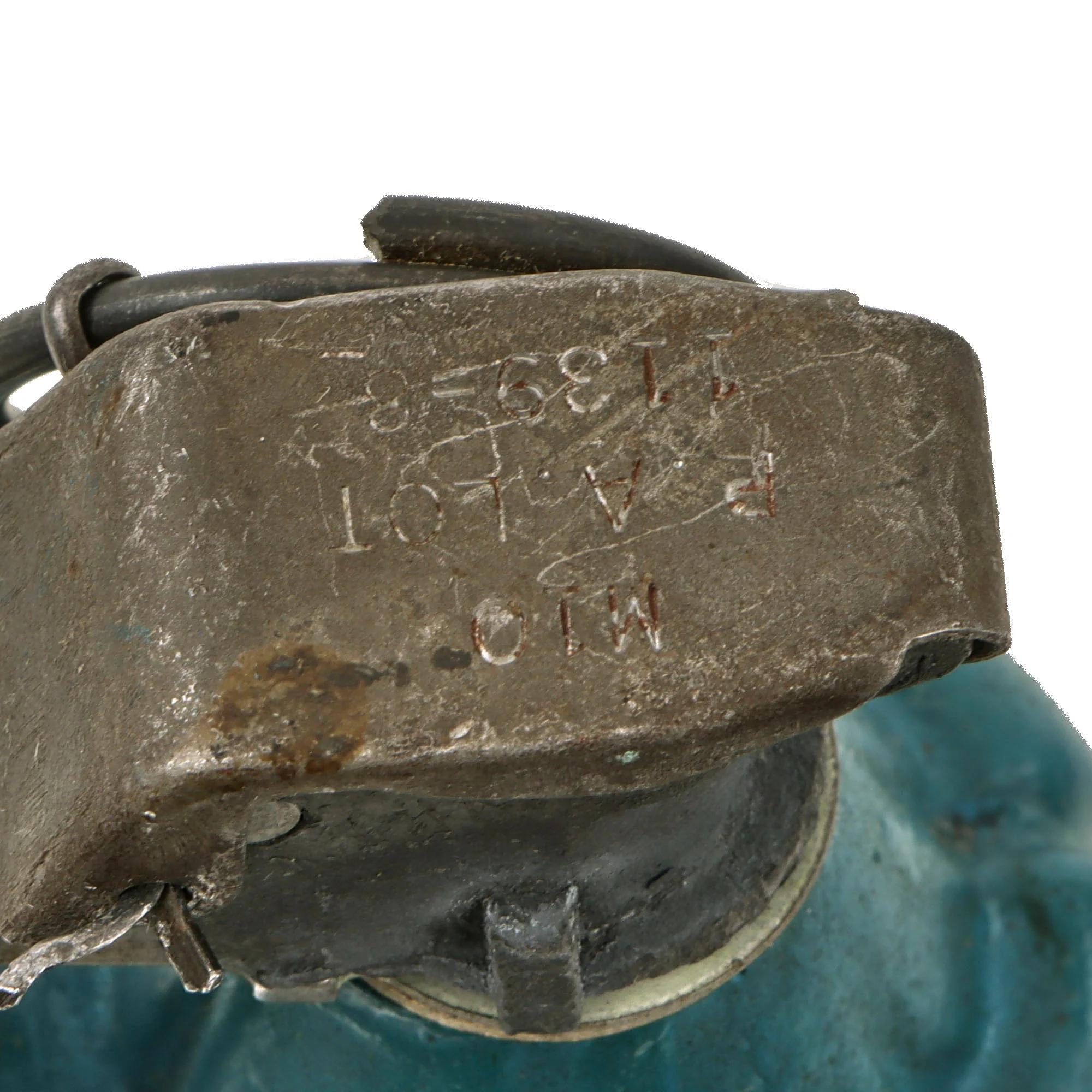
The fuze is marked:
M10
P.A. LOT
1139-8
The husk retains part of the original tag on the side reading:
1 - PRACTICE HAND GRENADE
LOT 1139-2 P.A. PACKED 2-39
DRAWING 82-0-1 P.R. 8-12-37
A great example of a U.S. WWII Practice Trainer Grenade with a scarce cutback fuze in its original correct husk, ready to display!
The Mk 2 grenade (initially known as the Mk II) is a fragmentation type anti-personnel hand grenade introduced by the U.S. armed forces in 1918. It was the standard issue anti-personnel grenade used during World War II, and also saw limited service in later conflicts, including the Korean War and Vietnam War. Replacing the failed Mk 1 grenade of 1917, it was standardized in 1920 as the Mk II, and redesignated the Mk 2 on April 2, 1945.
The Mk 2 was gradually phased out of service as the M26-series (M26/M61/M57) grenade was introduced during the Korean War. Due to the tremendous quantity manufactured during World War II the Mk 2 was still in limited issue with the US Army and US Marine Corps throughout the 1950s and 1960s. The U.S. Navy was one of the last users of the Mk 2 when it was finally withdrawn from U.S. military service in 1969, replaced with the M33 series (M33/M67).
The Mk 2 grenade did not widely replace the failed Mk 1 grenade used by the U.S. military during World War I. Although 44 million were ordered and more than 21 million were completed (it was possible to convert Mk 1 grenade bodies to the Mk 2 configuration) before the war ended, few reached American troops overseas. It was formally standardized in 1920. The Mk 2, like the Mk 1, was manufactured of cast iron with a grooved surface divided into 40 knobs in 5 rows of 8 columns. This was intended to enhance fragmentation (in practice, it was found that the grooves did not enhance fragmentation as much as desired) and provide a better grip when handling and throwing the grenade.
The grooves and knobs gave it the appearance of a pineapple, and are the origin of the nickname. It was also commonly referred to as a "frag" grenade, in contrast to other types of grenades such as the Mk 3 concussion grenade also developed during World War I.
The Mk 2 used the M5, M6, M10, M11, or M204 series fuses. The early M5, and the later M6 and M204 series detonating fuses, were used on high explosive-filled grenades. The M10 and M11 series igniting fuses were used on low explosive-filled ones. The early fuses had many problems. In the M5, moisture could get in under the foil fuse cap, causing the weapon to fail to detonate. The early fuses were not completely silent and made a loud "bang" and produced sparks when activated. They also made a faint "hissing" sound while burning, potentially alerting the enemy of their presence. The M10, used during the interwar period, and the M10A1, used early in WWII, sometimes prematurely detonated when the flash from the primer hit the explosive charge rather than the delay fuse. They were replaced by the M10A2 and M10A3. A less common type of igniting fuse was the M11.
The M6A4C had a delay of 4 seconds. The M5 and M11, like the M10, M10A1 and M10A2, had a delay of 4 to 5 seconds. The later M10A3 had a delay of 4.5 to 5.3 seconds. In 1944, the M6A4C was replaced by the silent and more reliable 4 to 5 second delay M204 or M204A1 fuse. Due to the large number of grenades already issued, few grenades with the new fuses were used in combat during WWII.

Details & Craftsmanship
Every detail has been carefully considered to bring you the perfect product.

Details & Craftsmanship
Every detail has been carefully considered to bring you the perfect product.

Details & Craftsmanship
Every detail has been carefully considered to bring you the perfect product.
Details & Craftsmanship
Every detail has been carefully considered to bring you the perfect product.

Details & Craftsmanship
Every detail has been carefully considered to bring you the perfect product.

Details & Craftsmanship
Every detail has been carefully considered to bring you the perfect product.
Details & Craftsmanship
Every detail has been carefully considered to bring you the perfect product.

Details & Craftsmanship
Every detail has been carefully considered to bring you the perfect product.

Details & Craftsmanship
Every detail has been carefully considered to bring you the perfect product.

Details & Craftsmanship
Every detail has been carefully considered to bring you the perfect product.

Details & Craftsmanship
Every detail has been carefully considered to bring you the perfect product.
Description
Original Item: Only One Available. Totally inert according to BATF guidelines with a hollow body and inert fuse. This is a great example of the M21 Practice Training grenade, an inert version of the iconic U.S. fragmentation pineapple grenade issued during WWII. The Mk II was standardized in 1920 replacing the Mk I of 1917. It was phased out gradually, the U.S. Navy being the last users, and on 2 April 1945 the Mk II and Mk IIA1 were re-designated the Mk 2 and Mk 2A1.
The Mk II was commonly known as a pineapple grenade, because of its shape and structure. Grooves were cast into the cast iron shell, which was believed at the time to aid in fragmentation and had the side benefit of aiding in gripping the grenade: this provision gave it the appearance of a pineapple fruit. The Mk II was identified with an all yellow body prior to 1943. They were then painted olive drab for camouflage purposes with a narrow yellow band below the fuse. There are numerous variations in the fragment and groove details that can be found, which seems to depend on the particular manufacturer.
This very nice WWII issue training grenade retains mostly all of the correct blue paint. This example is an early Circa 1939 tapered body example. It comes with an original early M10 cutback fuze and in its original correct husk. It is offered in very good condition. It has an open hollow end, as most practice grenades usually did.
Unloaded or dummy grenades, artillery shell casings, and similar devices, which are cut or drilled in an BATF-approved manner so that they cannot be used as ammunition components for destructive devices, are not considered NFA weapons. This example is in total compliance and is NOT AVAILABLE FOR EXPORT.
The fuze is marked:
M10
P.A. LOT
1139-8
The husk retains part of the original tag on the side reading:
1 - PRACTICE HAND GRENADE
LOT 1139-2 P.A. PACKED 2-39
DRAWING 82-0-1 P.R. 8-12-37
A great example of a U.S. WWII Practice Trainer Grenade with a scarce cutback fuze in its original correct husk, ready to display!
The Mk 2 grenade (initially known as the Mk II) is a fragmentation type anti-personnel hand grenade introduced by the U.S. armed forces in 1918. It was the standard issue anti-personnel grenade used during World War II, and also saw limited service in later conflicts, including the Korean War and Vietnam War. Replacing the failed Mk 1 grenade of 1917, it was standardized in 1920 as the Mk II, and redesignated the Mk 2 on April 2, 1945.
The Mk 2 was gradually phased out of service as the M26-series (M26/M61/M57) grenade was introduced during the Korean War. Due to the tremendous quantity manufactured during World War II the Mk 2 was still in limited issue with the US Army and US Marine Corps throughout the 1950s and 1960s. The U.S. Navy was one of the last users of the Mk 2 when it was finally withdrawn from U.S. military service in 1969, replaced with the M33 series (M33/M67).
The Mk 2 grenade did not widely replace the failed Mk 1 grenade used by the U.S. military during World War I. Although 44 million were ordered and more than 21 million were completed (it was possible to convert Mk 1 grenade bodies to the Mk 2 configuration) before the war ended, few reached American troops overseas. It was formally standardized in 1920. The Mk 2, like the Mk 1, was manufactured of cast iron with a grooved surface divided into 40 knobs in 5 rows of 8 columns. This was intended to enhance fragmentation (in practice, it was found that the grooves did not enhance fragmentation as much as desired) and provide a better grip when handling and throwing the grenade.
The grooves and knobs gave it the appearance of a pineapple, and are the origin of the nickname. It was also commonly referred to as a "frag" grenade, in contrast to other types of grenades such as the Mk 3 concussion grenade also developed during World War I.
The Mk 2 used the M5, M6, M10, M11, or M204 series fuses. The early M5, and the later M6 and M204 series detonating fuses, were used on high explosive-filled grenades. The M10 and M11 series igniting fuses were used on low explosive-filled ones. The early fuses had many problems. In the M5, moisture could get in under the foil fuse cap, causing the weapon to fail to detonate. The early fuses were not completely silent and made a loud "bang" and produced sparks when activated. They also made a faint "hissing" sound while burning, potentially alerting the enemy of their presence. The M10, used during the interwar period, and the M10A1, used early in WWII, sometimes prematurely detonated when the flash from the primer hit the explosive charge rather than the delay fuse. They were replaced by the M10A2 and M10A3. A less common type of igniting fuse was the M11.
The M6A4C had a delay of 4 seconds. The M5 and M11, like the M10, M10A1 and M10A2, had a delay of 4 to 5 seconds. The later M10A3 had a delay of 4.5 to 5.3 seconds. In 1944, the M6A4C was replaced by the silent and more reliable 4 to 5 second delay M204 or M204A1 fuse. Due to the large number of grenades already issued, few grenades with the new fuses were used in combat during WWII.