
The Story
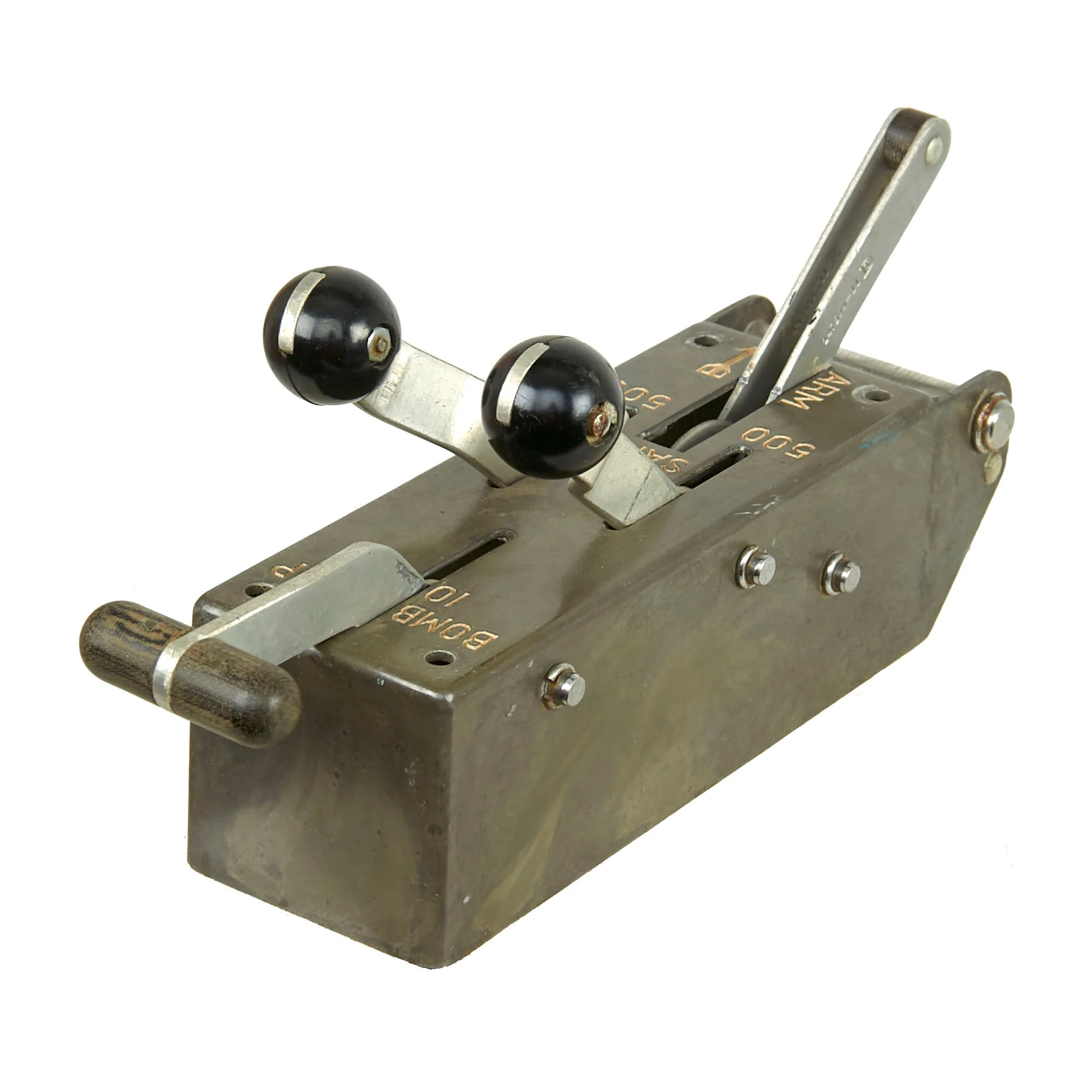
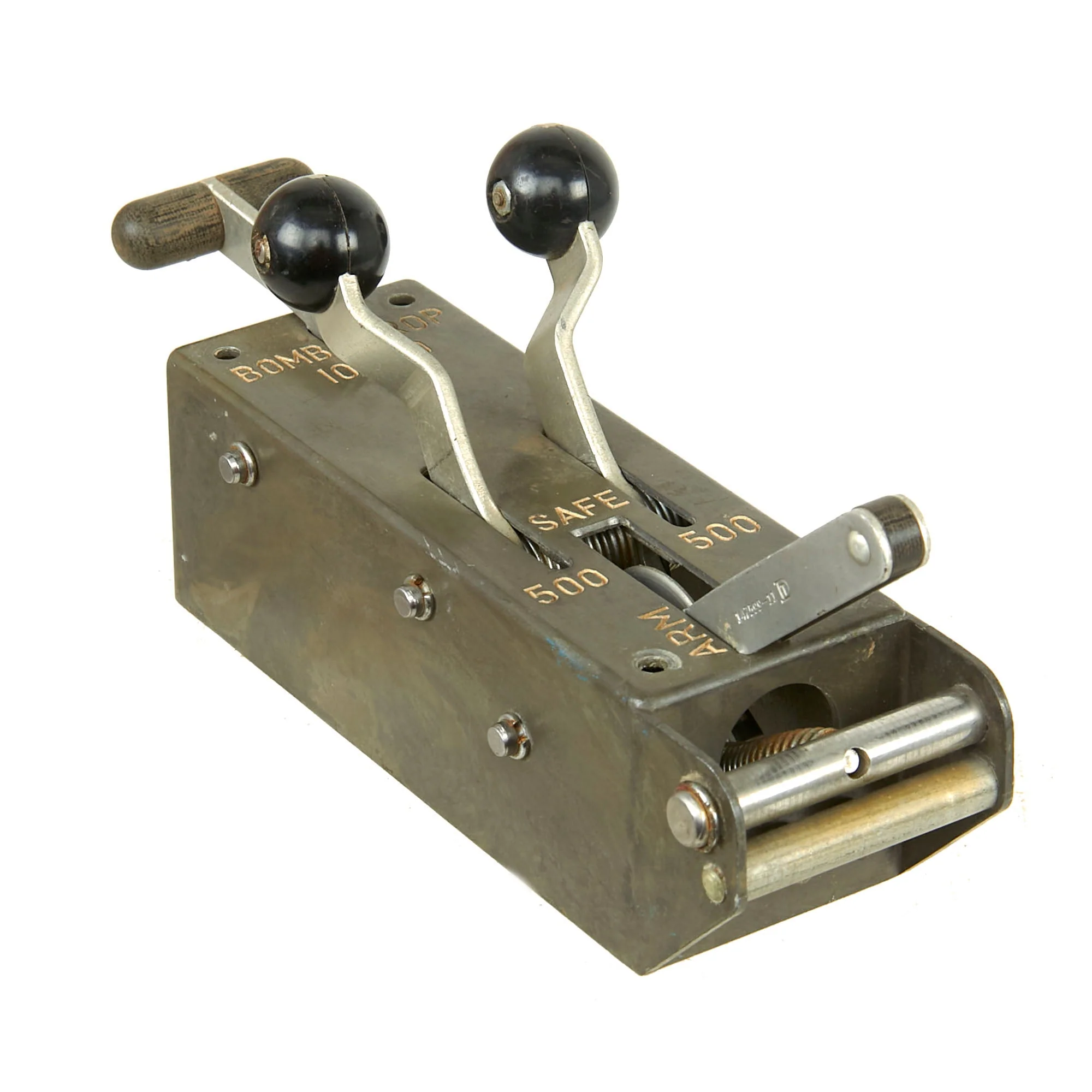
Original Item: Only One Available. These are rare as hens teeth and this is a wonderful example, complete with some great accessories, This is a very nice U.S. Army Air Forces Model M-9B head or "bombsight football" manufactured by Carl L. Norden Inc., serial N-7925. It has the correct data plate, with inspection marks, and interestingly has U.S. Navy "Anchor" inspection marks, even though it is a USAAF Bomb sight. The data plate still has the full manufacturer information listed on it:
U.S. ARMY AIR FORCES
BOMB SIGHT
M-9B N7925 U(Anchor)S
TYPE SERIAL NUMBER
44-1283
ORDER NO. SPEC. NO.
CARL. L. NORDEN, INC.
This would indicate that it was made under a 1944 contract, so it was produced later in the war. This example comes unissued with the original Warning tag still attached to the top, reading:
WARNING
BOMBSIGHT WILL BE MOUNTED ON STABILIZER AT ALL TIMES
THAT SIGHT HEAD IS IN AIRPLINE
Stowage of sight in any other manner will result in
Damaged bearings, etc.
This tag to be tied to gyro caging knob of bombsight
Head and left there until delivery to the tactical unit.
The original bombsight equipment data book is still attached, which notes it as a Type Mk. 15 M-9-B with serial number N.7925. The first page shows that it was converted to an M9B on March 18th, 1953. This is likely when the transport case and box are from as well.
Also included are a couple of reproduction data plates for a B-24 bomber, certainly meant to display with the sight.
The original plywood carrier is in very good condition, and the sight on the carrier measures 10¾ x 17¾ x 13½”. The large plywood cover for the carrier measures 10¾ x 17¾ x 13” and is stenciled on the top:
TOP
THIS SIDE UP
REUSABLE CONTAINER
DO NOT DESTROY
The original shipping box which the sight and carrier were contained in is still retained and in fair condition. It contains two large moisture packets which have broken open, and some of the covering for the sight. The box is stenciled on the side:
UNIT BOMB SIGHT
TYPE M-9B
STK NO 6400-964560
SER NO. N7925
QUAN ONE
OVERHAULED AT NOP1
The box measures 18¼ x 11¼ x 13¾.
This is a fantastic unissued set, likely the nicest Norden sight we have offered. Comes ready for further research and display!
The Norden Mk. XV, known as the Norden M series in Army service, was a bombsight used by the United States Army Air Forces (USAAF) and the United States Navy during World War II, and the United States Air Force in the Korean and the Vietnam Wars. It was the canonical tachometric design, a system that allowed it to directly measure the aircraft's ground speed and direction, which older bombsights could only measure inaccurately with lengthy in-flight procedures. The Norden further improved on older designs by using an analog computer that constantly calculated the bomb's impact point based on current flight conditions, and an autopilot that let it react quickly and accurately to changes in the wind or other effects.
Together, these features seemed to promise unprecedented accuracy in day bombing from high altitudes; in peacetime testing the Norden demonstrated a circular error probable (CEP) of 23 metres (75 ft), an astonishing performance for the era. This accuracy allowed direct attacks on ships, factories, and other point targets. Both the Navy and the AAF saw this as a means to achieve war aims through high-altitude bombing; for instance, destroying an invasion fleet by air long before it could reach US shores. To achieve these aims, the Norden was granted the utmost secrecy well into the war, and was part of a then-unprecedented production effort on the same scale as the Manhattan Project. Carl L. Norden, Inc. ranked 46th among United States corporations in the value of World War II military production contracts.
In practice it was not possible to achieve the expected accuracy in combat conditions, with the average CEP in 1943 of 370 metres (1,200 ft) being similar to Allied and German results. Both the Navy and Air Forces had to give up on the idea of pinpoint attacks during the war. The Navy turned to dive bombing and skip bombing to attack ships, while the Air Forces developed the lead bomber concept to improve accuracy, while adopting area bombing techniques by ever larger groups of aircraft. Nevertheless, the Norden's reputation as a pin-point device lived on, due in no small part to Norden's own advertising of the device after secrecy was reduced late in the war.
The Norden saw some use in the post-World War II era, especially during the Korean War. Post-war use was greatly reduced due to the introduction of radar-based systems, but the need for accurate daytime attacks kept it in service for some time. The last combat use of the Norden was in the US Navy's VO-67 squadron, which used them to drop sensors onto the Ho Chi Minh Trail as late as 1967. The Norden remains one of the best-known bombsights of all time.
As U.S. participation in the war started, the U.S. Army Air Forces drew up widespread and comprehensive bombing plans based on the Norden. They believed the B-17 had a 1.2% probability of hitting a 30 metres (100 ft) target from 6,100 metres (20,000 ft), meaning that 220 bombers would be needed for a 93% probability of one or more hits. This was not considered a problem, and the AAF forecast the need for 251 combat groups to provide enough bombers to fulfill their comprehensive pre-war plans.
After earlier combat trials proved troublesome, the Norden bombsight and its associated AFCE were used on a wide scale for the first time on the 18 March 1943 mission to Bremen-Vegesack, Germany; The 303d Bombardment Group dropped 76% of its load within a 300 metres (1,000 ft) ring, representing a CEP well under 300 m (1,000 ft) As at sea, many early missions over Europe demonstrated varied results; on wider inspection, only 50% of American bombs fell within a 400 metres (1⁄4 mi) of the target, and American flyers estimated that as many as 90% of bombs could miss their targets.[37][38][39] The average CEP in 1943 was 370 metres (1,200 ft), meaning that only 16% of the bombs fell within 300 metres (1,000 ft) of the aiming point. A 230-kilogram (500 lb) bomb, standard for precision missions after 1943, had a lethal radius of only 18 to 27 metres (60 to 90 ft).
Faced with these poor results, Curtis LeMay started a series of reforms in an effort to address the problems. In particular, he introduced the "combat box" formation in order to provide maximum defensive firepower by densely packing the bombers. As part of this change, he identified the best bombardiers in his command and assigned them to the lead bomber of each box. Instead of every bomber in the box using their Norden individually, the lead bombardiers were the only ones actively using the Norden, and the rest of the box followed in formation and then dropped their bombs when they saw the lead's leaving his aircraft. Although this spread the bombs over the area of the combat box, this could still improve accuracy over individual efforts. It also helped stop a problem where various aircraft, all slaved to their autopilots on the same target, would drift into each other. These changes did improve accuracy, which suggests that much of the problem is attributable to the bombardier. However, precision attacks still proved difficult or impossible.
When Jimmy Doolittle took over command of the 8th Air Force from Ira Eaker in early 1944, precision bombing attempts were dropped. Area bombing, like the RAF efforts, were widely used with 750 and then 1000 bomber raids against large targets. The main targets were railroad marshaling yards (27.4% of the bomb tonnage dropped), airfields (11.6%), oil refineries (9.5%), and military installations (8.8%). To some degree the targets were secondary missions; Doolittle used the bombers as an irresistible target to draw up Luftwaffe fighters into the ever-increasing swarms of Allied long-distance fighters. As these missions broke the Luftwaffe, missions were able to be carried out at lower altitudes or especially in bad weather when the H2X radar could be used. In spite of abandoning precision attacks, accuracy nevertheless improved. By 1945, the 8th was putting up to 60% of its bombs within 300 metres (1,000 ft), a CEP of about 270 metres (900 ft).

Details & Craftsmanship
Every detail has been carefully considered to bring you the perfect product.

Details & Craftsmanship
Every detail has been carefully considered to bring you the perfect product.

Details & Craftsmanship
Every detail has been carefully considered to bring you the perfect product.

Details & Craftsmanship
Every detail has been carefully considered to bring you the perfect product.

Details & Craftsmanship
Every detail has been carefully considered to bring you the perfect product.

Details & Craftsmanship
Every detail has been carefully considered to bring you the perfect product.

Details & Craftsmanship
Every detail has been carefully considered to bring you the perfect product.

Details & Craftsmanship
Every detail has been carefully considered to bring you the perfect product.

Details & Craftsmanship
Every detail has been carefully considered to bring you the perfect product.

Details & Craftsmanship
Every detail has been carefully considered to bring you the perfect product.

Details & Craftsmanship
Every detail has been carefully considered to bring you the perfect product.

Details & Craftsmanship
Every detail has been carefully considered to bring you the perfect product.

Details & Craftsmanship
Every detail has been carefully considered to bring you the perfect product.

Details & Craftsmanship
Every detail has been carefully considered to bring you the perfect product.

Details & Craftsmanship
Every detail has been carefully considered to bring you the perfect product.

Details & Craftsmanship
Every detail has been carefully considered to bring you the perfect product.

Details & Craftsmanship
Every detail has been carefully considered to bring you the perfect product.

Details & Craftsmanship
Every detail has been carefully considered to bring you the perfect product.

Details & Craftsmanship
Every detail has been carefully considered to bring you the perfect product.

Details & Craftsmanship
Every detail has been carefully considered to bring you the perfect product.

Details & Craftsmanship
Every detail has been carefully considered to bring you the perfect product.

Details & Craftsmanship
Every detail has been carefully considered to bring you the perfect product.

Details & Craftsmanship
Every detail has been carefully considered to bring you the perfect product.
Description
Original Item: Only One Available. These are rare as hens teeth and this is a wonderful example, complete with some great accessories, This is a very nice U.S. Army Air Forces Model M-9B head or "bombsight football" manufactured by Carl L. Norden Inc., serial N-7925. It has the correct data plate, with inspection marks, and interestingly has U.S. Navy "Anchor" inspection marks, even though it is a USAAF Bomb sight. The data plate still has the full manufacturer information listed on it:
U.S. ARMY AIR FORCES
BOMB SIGHT
M-9B N7925 U(Anchor)S
TYPE SERIAL NUMBER
44-1283
ORDER NO. SPEC. NO.
CARL. L. NORDEN, INC.
This would indicate that it was made under a 1944 contract, so it was produced later in the war. This example comes unissued with the original Warning tag still attached to the top, reading:
WARNING
BOMBSIGHT WILL BE MOUNTED ON STABILIZER AT ALL TIMES
THAT SIGHT HEAD IS IN AIRPLINE
Stowage of sight in any other manner will result in
Damaged bearings, etc.
This tag to be tied to gyro caging knob of bombsight
Head and left there until delivery to the tactical unit.
The original bombsight equipment data book is still attached, which notes it as a Type Mk. 15 M-9-B with serial number N.7925. The first page shows that it was converted to an M9B on March 18th, 1953. This is likely when the transport case and box are from as well.
Also included are a couple of reproduction data plates for a B-24 bomber, certainly meant to display with the sight.
The original plywood carrier is in very good condition, and the sight on the carrier measures 10¾ x 17¾ x 13½”. The large plywood cover for the carrier measures 10¾ x 17¾ x 13” and is stenciled on the top:
TOP
THIS SIDE UP
REUSABLE CONTAINER
DO NOT DESTROY
The original shipping box which the sight and carrier were contained in is still retained and in fair condition. It contains two large moisture packets which have broken open, and some of the covering for the sight. The box is stenciled on the side:
UNIT BOMB SIGHT
TYPE M-9B
STK NO 6400-964560
SER NO. N7925
QUAN ONE
OVERHAULED AT NOP1
The box measures 18¼ x 11¼ x 13¾.
This is a fantastic unissued set, likely the nicest Norden sight we have offered. Comes ready for further research and display!
The Norden Mk. XV, known as the Norden M series in Army service, was a bombsight used by the United States Army Air Forces (USAAF) and the United States Navy during World War II, and the United States Air Force in the Korean and the Vietnam Wars. It was the canonical tachometric design, a system that allowed it to directly measure the aircraft's ground speed and direction, which older bombsights could only measure inaccurately with lengthy in-flight procedures. The Norden further improved on older designs by using an analog computer that constantly calculated the bomb's impact point based on current flight conditions, and an autopilot that let it react quickly and accurately to changes in the wind or other effects.
Together, these features seemed to promise unprecedented accuracy in day bombing from high altitudes; in peacetime testing the Norden demonstrated a circular error probable (CEP) of 23 metres (75 ft), an astonishing performance for the era. This accuracy allowed direct attacks on ships, factories, and other point targets. Both the Navy and the AAF saw this as a means to achieve war aims through high-altitude bombing; for instance, destroying an invasion fleet by air long before it could reach US shores. To achieve these aims, the Norden was granted the utmost secrecy well into the war, and was part of a then-unprecedented production effort on the same scale as the Manhattan Project. Carl L. Norden, Inc. ranked 46th among United States corporations in the value of World War II military production contracts.
In practice it was not possible to achieve the expected accuracy in combat conditions, with the average CEP in 1943 of 370 metres (1,200 ft) being similar to Allied and German results. Both the Navy and Air Forces had to give up on the idea of pinpoint attacks during the war. The Navy turned to dive bombing and skip bombing to attack ships, while the Air Forces developed the lead bomber concept to improve accuracy, while adopting area bombing techniques by ever larger groups of aircraft. Nevertheless, the Norden's reputation as a pin-point device lived on, due in no small part to Norden's own advertising of the device after secrecy was reduced late in the war.
The Norden saw some use in the post-World War II era, especially during the Korean War. Post-war use was greatly reduced due to the introduction of radar-based systems, but the need for accurate daytime attacks kept it in service for some time. The last combat use of the Norden was in the US Navy's VO-67 squadron, which used them to drop sensors onto the Ho Chi Minh Trail as late as 1967. The Norden remains one of the best-known bombsights of all time.
As U.S. participation in the war started, the U.S. Army Air Forces drew up widespread and comprehensive bombing plans based on the Norden. They believed the B-17 had a 1.2% probability of hitting a 30 metres (100 ft) target from 6,100 metres (20,000 ft), meaning that 220 bombers would be needed for a 93% probability of one or more hits. This was not considered a problem, and the AAF forecast the need for 251 combat groups to provide enough bombers to fulfill their comprehensive pre-war plans.
After earlier combat trials proved troublesome, the Norden bombsight and its associated AFCE were used on a wide scale for the first time on the 18 March 1943 mission to Bremen-Vegesack, Germany; The 303d Bombardment Group dropped 76% of its load within a 300 metres (1,000 ft) ring, representing a CEP well under 300 m (1,000 ft) As at sea, many early missions over Europe demonstrated varied results; on wider inspection, only 50% of American bombs fell within a 400 metres (1⁄4 mi) of the target, and American flyers estimated that as many as 90% of bombs could miss their targets.[37][38][39] The average CEP in 1943 was 370 metres (1,200 ft), meaning that only 16% of the bombs fell within 300 metres (1,000 ft) of the aiming point. A 230-kilogram (500 lb) bomb, standard for precision missions after 1943, had a lethal radius of only 18 to 27 metres (60 to 90 ft).
Faced with these poor results, Curtis LeMay started a series of reforms in an effort to address the problems. In particular, he introduced the "combat box" formation in order to provide maximum defensive firepower by densely packing the bombers. As part of this change, he identified the best bombardiers in his command and assigned them to the lead bomber of each box. Instead of every bomber in the box using their Norden individually, the lead bombardiers were the only ones actively using the Norden, and the rest of the box followed in formation and then dropped their bombs when they saw the lead's leaving his aircraft. Although this spread the bombs over the area of the combat box, this could still improve accuracy over individual efforts. It also helped stop a problem where various aircraft, all slaved to their autopilots on the same target, would drift into each other. These changes did improve accuracy, which suggests that much of the problem is attributable to the bombardier. However, precision attacks still proved difficult or impossible.
When Jimmy Doolittle took over command of the 8th Air Force from Ira Eaker in early 1944, precision bombing attempts were dropped. Area bombing, like the RAF efforts, were widely used with 750 and then 1000 bomber raids against large targets. The main targets were railroad marshaling yards (27.4% of the bomb tonnage dropped), airfields (11.6%), oil refineries (9.5%), and military installations (8.8%). To some degree the targets were secondary missions; Doolittle used the bombers as an irresistible target to draw up Luftwaffe fighters into the ever-increasing swarms of Allied long-distance fighters. As these missions broke the Luftwaffe, missions were able to be carried out at lower altitudes or especially in bad weather when the H2X radar could be used. In spite of abandoning precision attacks, accuracy nevertheless improved. By 1945, the 8th was putting up to 60% of its bombs within 300 metres (1,000 ft), a CEP of about 270 metres (900 ft).