
Original: $895.00
-70%$895.00
$268.50The Story
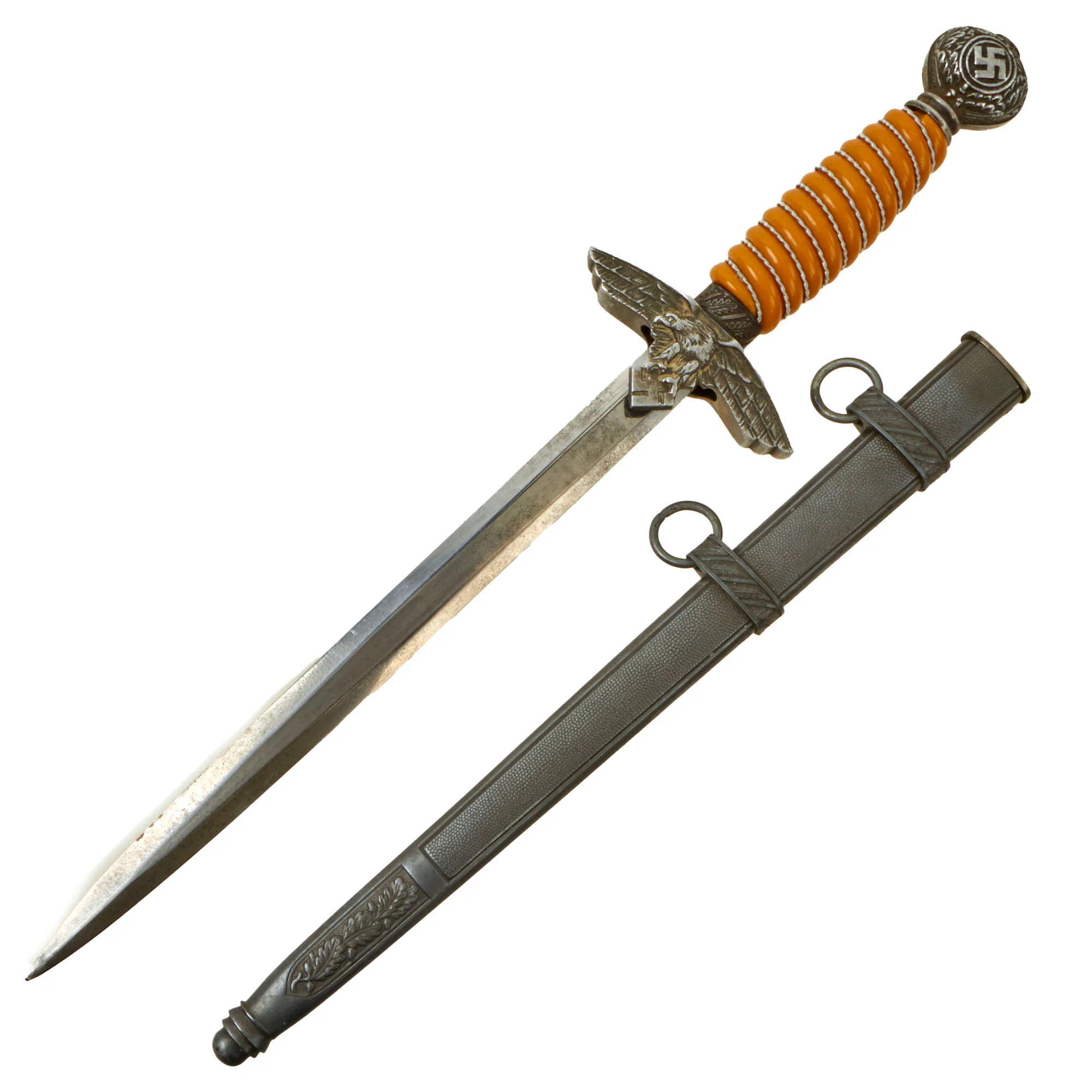
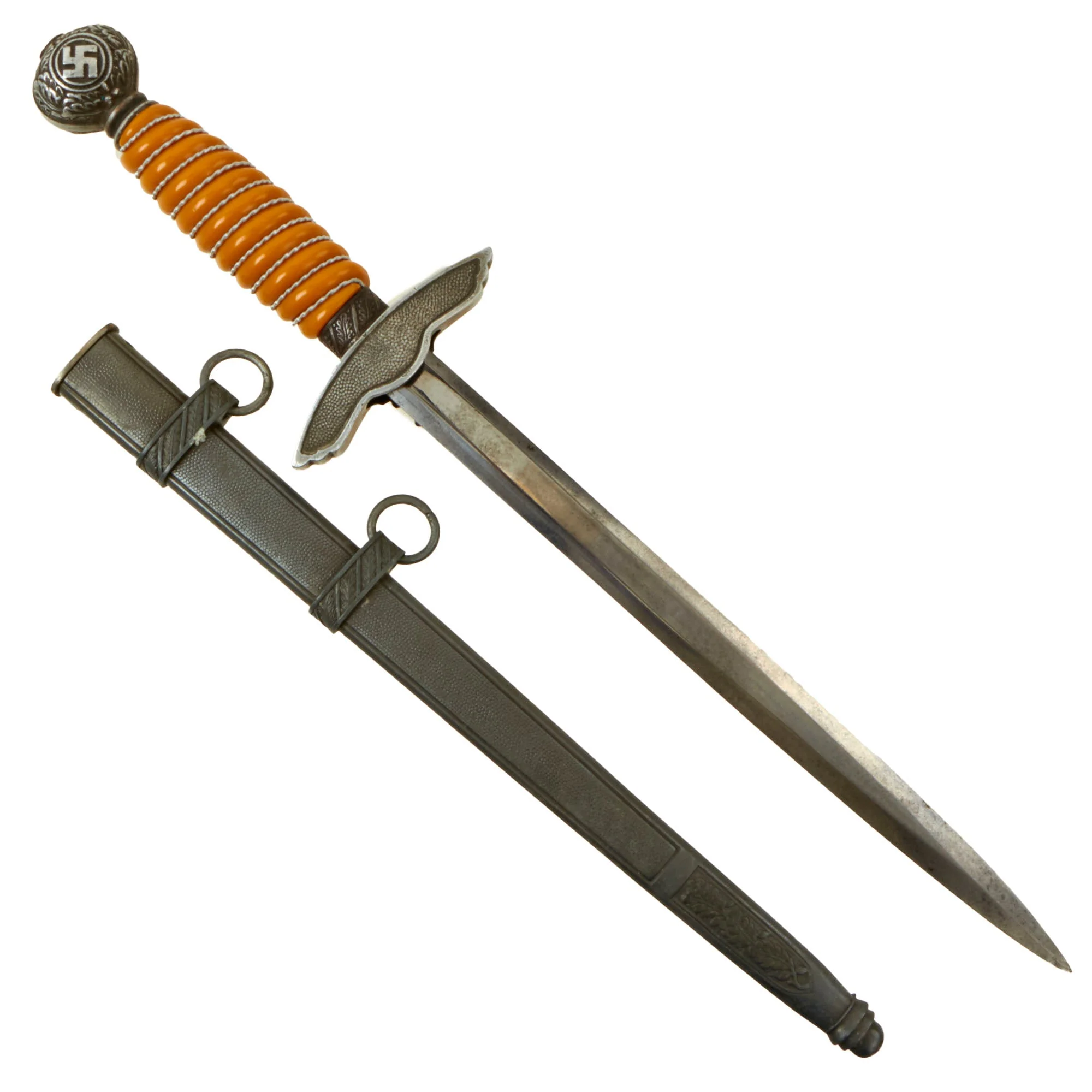
Original Item: Only One Available. This is a lovely example of a mid-war production 2nd Model Luftwaffe dagger. It is a fine Solingen-Produced example made by the Solingen-based firm of ALCOSO - Alexander Coppel & Co. KG, Stahlwarenfabrik. The celluloid covered wooden grip of this dagger is a nice light ivory white color, and has not faded to orange as they so often do. It remains in very good condition throughout, showing some light staining and dirt, as well as an area that looks like it may have been exposed to a solvent or heat. It has a nice slightly tapered shape, and is tightly wrapped with bullion wrapped twisted wires, which show oxidation from use.
The hilt mounts are in similar condition with a lovely patina of age. The pommel is very good and still shows most of the original detail. The "mobile" swass on both sides are clear and the oak leaves around them are raised out and heavily hand enhanced. The pommel appears to be solid aluminum, and has lovely "airplane grey" oxide plating, showing wear through to the aluminum on the raised areas.
The cross guard is also made of airplane gray oxide coated Aluminum, which was an "Air Age" material, used to make most airplanes. It was considered fitting and desirable for the eagle-shaped guard to be made of this material. The front side is an eagle with a breast and talon area that is vaulted out much more so than the cross guards seen on other types of daggers. This guard shows little wear and has great feathering on the eagle. The bird, of course, flies to the left and grasps a mobile swas in his talons. The reverse panel is decorated with small pebbling, which is still clear. The oxide coating is still well retained, though not as good as on the pommel, showing wear around all the edges. The ferrule looks to be plated steel, and is in very good condition, with a nice dark patina where the plating is worn away.
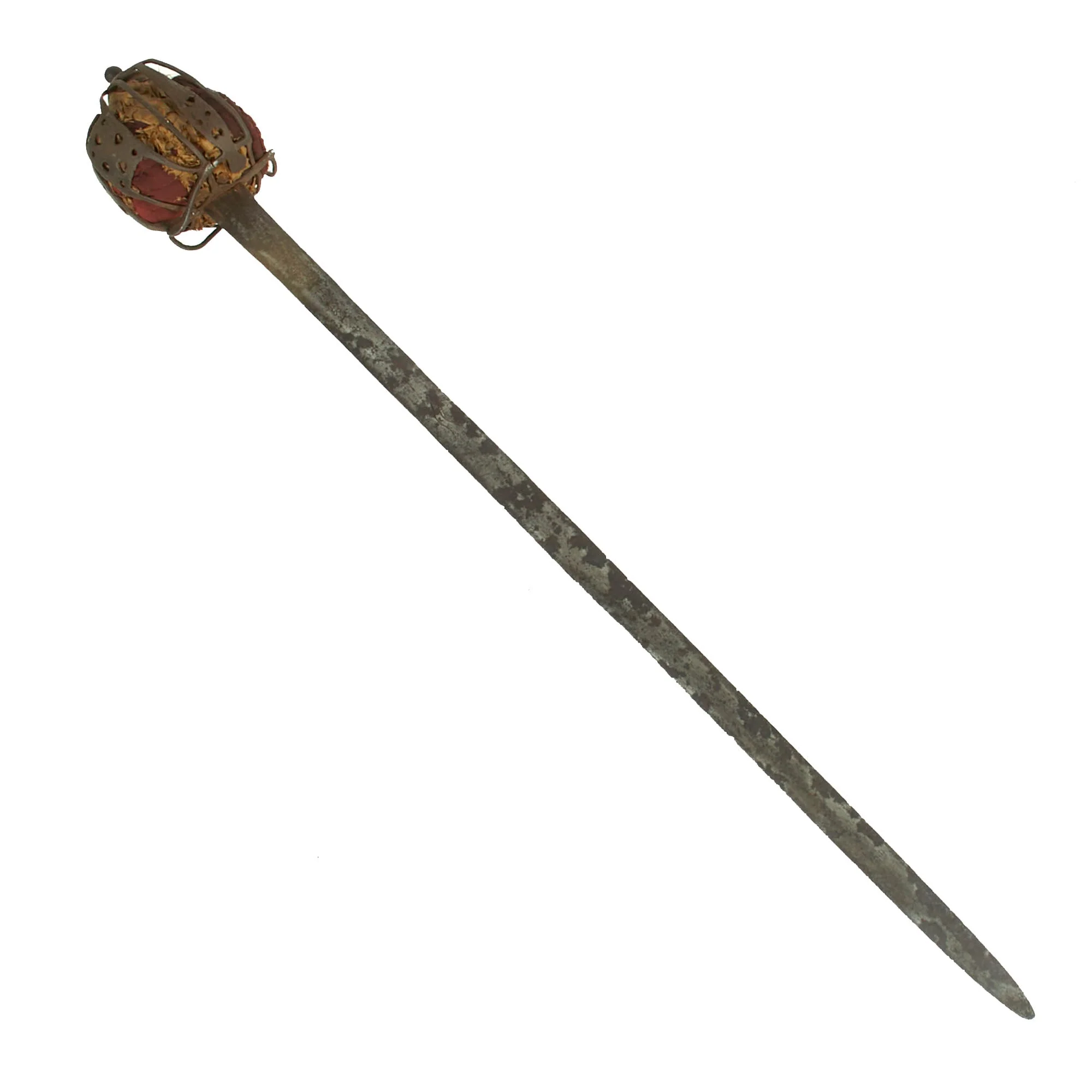
The blade on this example is not nickel plated, which is common for later produced blades, and is in very good near excellent condition. Both shits still show the original factory final polish grind throughout the blade surfaces, with only light wear from runners and some from cleaning near the tip, which shows some oxidation staining. This texture is iconic, and is the definitive identifying characteristic for a real WWII German Blade. 80% of the blade surface is in near mint condition, with the two inches nearest the tip showing scattered staining from water, but no pitting or more serious oxidation. We have left this intact to avoid marring the cross grain in that area. The original leather blade buffer is in place within the deep recesses of the guard.
The reverse ricasso is etched with the trademark Alcoso used from 1936-1939. It depicts the scales with the firm's initials, ACS interspersed. To the right is the firm's name in in script, Alcoso, and below the town of business, SOLINGEN, the legendary "City of Blades" in Western Germany.
Alcoso is a trade name of Alexander Coppel & Co. KG, Stahlwarenfabrik, located in Solingen, the legendary German "City of Blades." Per J. Anthony Carter's fine work GERMAN SWORD AND KNIFE MAKERS, the company was a major manufacturer of edged weapons and tools from the end of the 19th century up until the WWII period. Unfortunately, as NSDAP-control increased, brothers Carl Gustav and Dr. Alexander Coppel, the Jewish owners of the firm, were forced out. In 1936 the firm had been "Aryanized", and started using the name ALCOSO to hide the Jewish family name. By the end of 1936 the brothers were ejected from their Solingen offices, and by 1940 the brand trademark initials ACS were changed to AWS to reflect the change in ownership and name: Alexander Coppel Solingen to Alcoso-Werk Solingen. Carl Gustav Coppel committed suicide in Solingen in 1941, and Dr. Alexander Coppel was arrested in 1942 and sent to Theresienstadt Prison camp, where he died August 5th 1942. The factory itself was destroyed by Allied bombers in November 1944.
The scabbard is a typical Alcoso type, having the distinctive rounded shape to the shell, showing a dent and slight bend about 2/3 of the way down the length. It still retains much of the original "airplane gray" finish, which looks to be oxidized zinc plating, with only a few areas on the sides showing loss. It still retains the finely pebbled panels on both sides, with the correct finely toothed oak leaves and acorns on the panel nearest the drag. The hanging bands are aluminum, and have worn, losing a good amount of the grey finish. The throat is held in placed by two "cheesehead" screws on the narrow sides of the scabbard, and show no signs of turning.
Attached to the scabbard is a very nice belt hanger, with all spring clips fully functional. The scabbard end clips are the more complex and desirable sliding type. The buckles and keepers are embossed with the same oak and acorn motif seen throughout the dagger, and are made from zinc alloy. The hardware is marked D.R.G.M., indicating that these were registered in the German trademark office. The end clip is also marked on the back with RZM and maker code U.E. 10.. "U.E" indicates Uniformeffekten Erlaubnißschein, (Uniform Accessories Licence), and the manufacturer’s numerical code, "10". It appears the combined RZM/U.E., markings were utilized circa May 1933 to March 1935. These were used when the RZM was still being officially organized. There is unfortunately no listing of the early RZM makers.
This really is a very nice 2nd Model Luftwaffe Dagger, offered in very good condition, from a maker with a somber back story.
Specifications:
Blade Length: 10"
Overall length: 15 1/2”
Crossguard: 3 1/4”
Scabbard Length: 11 3/4”

Details & Craftsmanship
Every detail has been carefully considered to bring you the perfect product.

Details & Craftsmanship
Every detail has been carefully considered to bring you the perfect product.

Details & Craftsmanship
Every detail has been carefully considered to bring you the perfect product.

Details & Craftsmanship
Every detail has been carefully considered to bring you the perfect product.

Details & Craftsmanship
Every detail has been carefully considered to bring you the perfect product.

Details & Craftsmanship
Every detail has been carefully considered to bring you the perfect product.

Details & Craftsmanship
Every detail has been carefully considered to bring you the perfect product.

Details & Craftsmanship
Every detail has been carefully considered to bring you the perfect product.

Details & Craftsmanship
Every detail has been carefully considered to bring you the perfect product.

Details & Craftsmanship
Every detail has been carefully considered to bring you the perfect product.

Details & Craftsmanship
Every detail has been carefully considered to bring you the perfect product.

Details & Craftsmanship
Every detail has been carefully considered to bring you the perfect product.

Details & Craftsmanship
Every detail has been carefully considered to bring you the perfect product.

Details & Craftsmanship
Every detail has been carefully considered to bring you the perfect product.

Details & Craftsmanship
Every detail has been carefully considered to bring you the perfect product.
Description
Original Item: Only One Available. This is a lovely example of a mid-war production 2nd Model Luftwaffe dagger. It is a fine Solingen-Produced example made by the Solingen-based firm of ALCOSO - Alexander Coppel & Co. KG, Stahlwarenfabrik. The celluloid covered wooden grip of this dagger is a nice light ivory white color, and has not faded to orange as they so often do. It remains in very good condition throughout, showing some light staining and dirt, as well as an area that looks like it may have been exposed to a solvent or heat. It has a nice slightly tapered shape, and is tightly wrapped with bullion wrapped twisted wires, which show oxidation from use.
The hilt mounts are in similar condition with a lovely patina of age. The pommel is very good and still shows most of the original detail. The "mobile" swass on both sides are clear and the oak leaves around them are raised out and heavily hand enhanced. The pommel appears to be solid aluminum, and has lovely "airplane grey" oxide plating, showing wear through to the aluminum on the raised areas.
The cross guard is also made of airplane gray oxide coated Aluminum, which was an "Air Age" material, used to make most airplanes. It was considered fitting and desirable for the eagle-shaped guard to be made of this material. The front side is an eagle with a breast and talon area that is vaulted out much more so than the cross guards seen on other types of daggers. This guard shows little wear and has great feathering on the eagle. The bird, of course, flies to the left and grasps a mobile swas in his talons. The reverse panel is decorated with small pebbling, which is still clear. The oxide coating is still well retained, though not as good as on the pommel, showing wear around all the edges. The ferrule looks to be plated steel, and is in very good condition, with a nice dark patina where the plating is worn away.
The blade on this example is not nickel plated, which is common for later produced blades, and is in very good near excellent condition. Both shits still show the original factory final polish grind throughout the blade surfaces, with only light wear from runners and some from cleaning near the tip, which shows some oxidation staining. This texture is iconic, and is the definitive identifying characteristic for a real WWII German Blade. 80% of the blade surface is in near mint condition, with the two inches nearest the tip showing scattered staining from water, but no pitting or more serious oxidation. We have left this intact to avoid marring the cross grain in that area. The original leather blade buffer is in place within the deep recesses of the guard.
The reverse ricasso is etched with the trademark Alcoso used from 1936-1939. It depicts the scales with the firm's initials, ACS interspersed. To the right is the firm's name in in script, Alcoso, and below the town of business, SOLINGEN, the legendary "City of Blades" in Western Germany.
Alcoso is a trade name of Alexander Coppel & Co. KG, Stahlwarenfabrik, located in Solingen, the legendary German "City of Blades." Per J. Anthony Carter's fine work GERMAN SWORD AND KNIFE MAKERS, the company was a major manufacturer of edged weapons and tools from the end of the 19th century up until the WWII period. Unfortunately, as NSDAP-control increased, brothers Carl Gustav and Dr. Alexander Coppel, the Jewish owners of the firm, were forced out. In 1936 the firm had been "Aryanized", and started using the name ALCOSO to hide the Jewish family name. By the end of 1936 the brothers were ejected from their Solingen offices, and by 1940 the brand trademark initials ACS were changed to AWS to reflect the change in ownership and name: Alexander Coppel Solingen to Alcoso-Werk Solingen. Carl Gustav Coppel committed suicide in Solingen in 1941, and Dr. Alexander Coppel was arrested in 1942 and sent to Theresienstadt Prison camp, where he died August 5th 1942. The factory itself was destroyed by Allied bombers in November 1944.
The scabbard is a typical Alcoso type, having the distinctive rounded shape to the shell, showing a dent and slight bend about 2/3 of the way down the length. It still retains much of the original "airplane gray" finish, which looks to be oxidized zinc plating, with only a few areas on the sides showing loss. It still retains the finely pebbled panels on both sides, with the correct finely toothed oak leaves and acorns on the panel nearest the drag. The hanging bands are aluminum, and have worn, losing a good amount of the grey finish. The throat is held in placed by two "cheesehead" screws on the narrow sides of the scabbard, and show no signs of turning.
Attached to the scabbard is a very nice belt hanger, with all spring clips fully functional. The scabbard end clips are the more complex and desirable sliding type. The buckles and keepers are embossed with the same oak and acorn motif seen throughout the dagger, and are made from zinc alloy. The hardware is marked D.R.G.M., indicating that these were registered in the German trademark office. The end clip is also marked on the back with RZM and maker code U.E. 10.. "U.E" indicates Uniformeffekten Erlaubnißschein, (Uniform Accessories Licence), and the manufacturer’s numerical code, "10". It appears the combined RZM/U.E., markings were utilized circa May 1933 to March 1935. These were used when the RZM was still being officially organized. There is unfortunately no listing of the early RZM makers.
This really is a very nice 2nd Model Luftwaffe Dagger, offered in very good condition, from a maker with a somber back story.
Specifications:
Blade Length: 10"
Overall length: 15 1/2”
Crossguard: 3 1/4”
Scabbard Length: 11 3/4”