
Original WWII Japanese RJT Rinji Seikishi Shin-Gunto Handmade Katana Sword by KOJIMA KANENORI with Tassel and Soldier Named Fabric Wrapped Scabbard
Original WWII Japanese RJT Rinji Seikishi Shin-Gunto Handmade Katana Sword by KOJIMA KANENORI with Tassel and Soldier Named Fabric Wrapped Scabbard
The Story
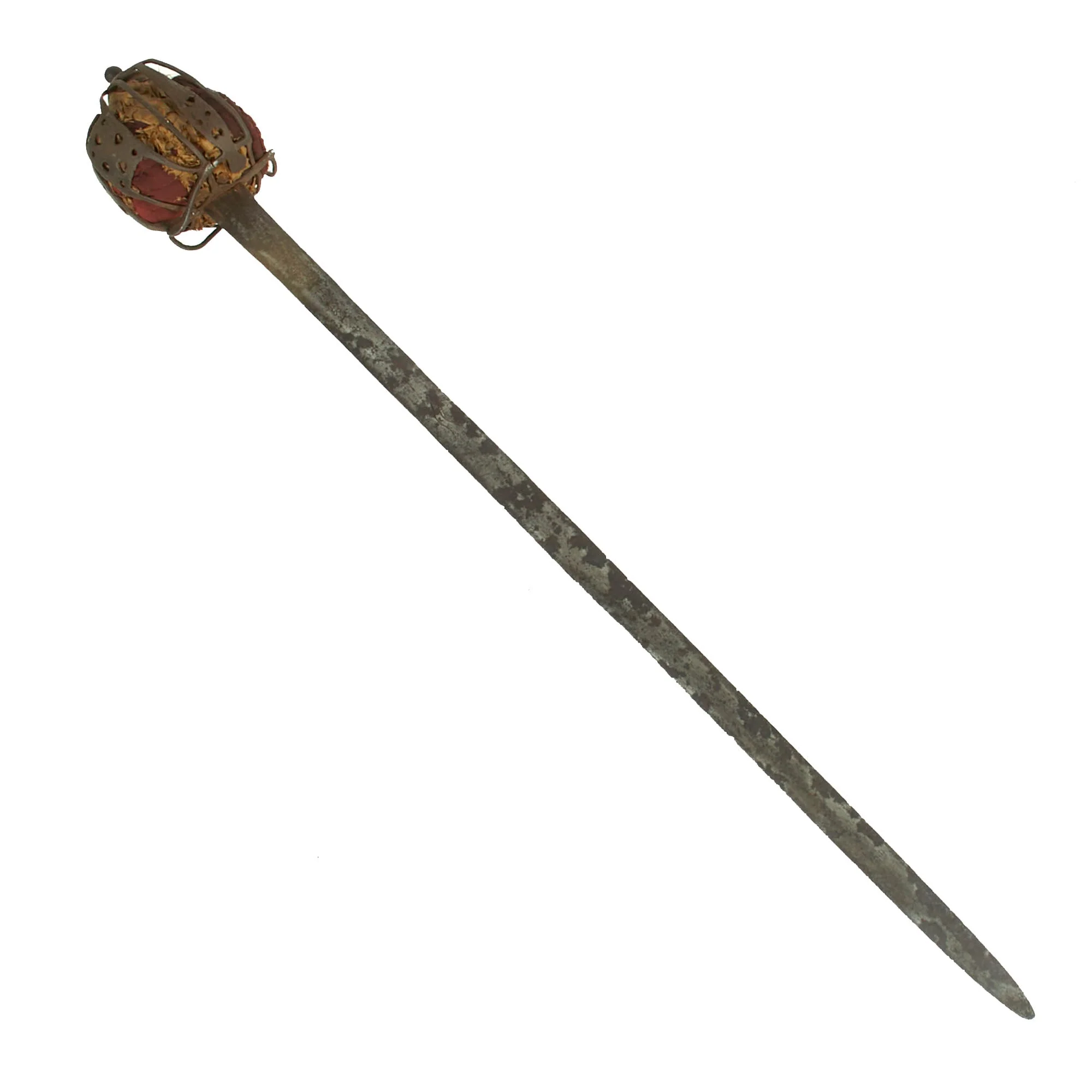
Original Item: One of a Kind. Recently purchased at a large military auction, this is a great USGI Bring-Back wartime production high grade Japanese officer Katana in the Rikugun Jumei Tosho fittings. These were a high grade of variation of the 臨時正式 (Rinji Seikishi) or "Special Contingency" version of the Type 98 Shin-Gunto (九八式軍刀 kyūhachi-shiki guntō) setting. They usually feature a textured lacquered scabbard, as well as a blade lock that has releases on both sides of the crossguard, not seen on the "regular" version of the Rinji Seishiki. The cross screws through the handle, instead of the usual wooden or bamboo pegs, is another change made.
These fittings, while often called the P-1944, were in fact designed in 1938, but didn't really see much use until 1940. They were designed to be more robust than the regular Type 98 fittings, as well as less expensive and time consuming to produce. However the standard Type 98 fittings continued to be produced concurrently until almost the end of the war. The blade tang on this RJT Shin-Gunto is signed by the maker, and is handmade in the traditional fashion. A Shin-Guntō (新軍刀, new military sword) is a weapon and symbol of rank used by the Imperial Japanese Army between the years of 1935 and 1945.
The katana features a very nice company grade rank tassel attached to the pommel, and also has a fantastic fabric cover on the scabbard, which has had a very large "capture tag" attached, which is not only written in Japanese characters, but also in English! We have never seen something like this before, and it adds some fantastic future research potential to this item! It is signed on the bottom of the Japanese section with 陸軍少尉 笹山 忠住 - read as "Rikugun-Shōi Sasayama Tadayoshi", and the English side reads as follows:
Tōkaidō line, Kyōtō Station, 240 Nishi-
Uoyachō. Muromachinishiirū, Rokujyōdori,
Shimokyōku, Kyoto
Sub-leutenant. Tadayoshi Sasayama.
The Rikugun Jumei Tosho were swordsmiths certified by the Army headquarters of Japan during wartime. Their names first appear in "Rikugun Jumei Tosho Meibo (1933)" and it is believed that they produced blades for highly ranked officers. Besides Yasukuni tosho and Minatogawa tosho, these smiths all produced Gendaito (traditionally made blades), which should be discerned from Showato (arsenal forged blades). A star stamp was marked on the blade tang when passed by Rikugun Shinsa Inspection, however there were RJT smiths that did not have them inspected routinely.
The blade on this example was hand forged, and the tang of the blade is signed (Mei) with the characters 濃 住 小島 兼則 之 作, read as NO [SHU] JU KOJIMA KANENORI KORE SAKU. This basically translates to "Kojima Kanenori made this in Noshu (Mino) Province." Research indicates that this smith's real name was 小島 太郎 (Kojima Tarou), so in this case "Kojima" was their family name, and "Kananori" their "swordsmith name." We have examined other examples of their signature (Oshigata), and confirmed the style. They are on the "Rikugun Jumei Tosho Meibo (1933)" list, and made high quality blades. The tang has the correct "Star" stamp on the upper left side of the tang above the mei, indicating it passed the Rikugun Shinsa examination.
This smith is also listed in Kurihara Hikosaburo's 1942 listing of Wartime Japanese swordsmiths (tosho). He reported about 400 gunto tosho's ranking at the Tosho Banzuke (刀匠番附), and classified these into 7 ranks. KANENORI is listed as a 中上作 (CHUJO SAKU) = 上工の上位 (Joko no Joi) level smith, which is the 4th rank out of 7, an "upper middle" level smith. Considering that most smiths were not even rated, this is quite a high ranking. KANENORI also appears also in the Seki Tanrensho Booklet printed in 1939, and they were active during the Showa Period and worked at Seki arsenal in Gifu, Mino Province (美濃国).
The other side of the tang bears the date when the blade was produced, in the standard long form indicating years into the current emperor's reign: 昭 和 十 九 年 五 月. This would be read: SHOWA (current reigning emperor) Juu-Kyuu Nen (19th year of reign - 1944) Juuni-Gatsu (5th Month - May). The YASURIME (鑢目 - file marks) on the tang are still well retained with light oxidation, and the signature is still strongly struck, though the style of signature makes it difficult to take pictures of.
The blade is handmade and was expertly crafted by a sword maker, which is indicated by a few tell-tale characteristics that include:
- Holes in the tang (mekugi-ana) are punched and not drilled.
- Visible Vibrant temper line ("hamon") with crystallization visible (Nie and Nioi) along the transition.
- Visible grain (hada) in the blade body (ji), only possible with laminated steel.
- Blade is signed on the tang by the maker ("Mei")
- Blade has a proper geometric Yokote at the tip (kissaki) with a Boshi (tip temper line)
Offered in very good condition, the blade is still VERY sharp and looks great, so it should be handled with care. There are no bends or dents we can see, just some roughness in areas on the edge. The overall polish is still excellent, showing just a bit of wear on the very edge and some scattered staining. The aspects of the blade and temper line are easily seen in any type of light, and it is really lovely. Blade length is approximately 25 ⅞ inches and overall length of 37 ¼ inches. The katana has a handmade blade with a Futsu 普通 (regular) Nakago (tang) with a Haagari (asymmetrical rounded) nakago-jiri (tang tip).
The main edge HAMON (刃文 - wave or temper line) is fully visible, and is a very attractive NOTARE MIDARE (湾れ乱れ - irregular wave like) shape, with lots of internal activity. Along the transition there are clear NIE crystals visible, with cloudy areas of NIOI in the body of the hamon. The body of the blade (JI) also shows hada (肌 - grain), which is the MASAME (柾目 Straight) pattern, typical for this era. The blade has a proper geometric KISSAKI (切先 - point of blade) with a clear YOKOTE (横手 - line between ji and kissaki). The BOSHI ( 帽子 - tip temper line) is of the Ō-MARU (大丸- large round turnback) shape, and is mostly visible with a clear transition. There are also some KIZU blade wounds visible, both WARE lamination lines and FUKURE carbon pits, only possible on true handmade blades. This is really a fantastic looking blade! With the long delay for traditional togishi polishing, blades like this that are ready to display are definitely in demand.
The blade mountings are the typical Rikugun Jumei Tosho Army style, similar to the P-1944. MARU GATA (round shaped) iron tsuba (cross guard) with no decorations, a plated copper habaki (blade collar), with an iron fuchi (grip collar). There are three seppa (spacers) surrounding the tsuba, properly inlet for the scabbard lock, and the one closest to the blade is "cup" shaped. The scabbard lock is present and fully functional, but unlike the usual pattern, there are release buttons on both the fuchi and on the scabbard itself.
The tsuka (handle) has black painted brass Imperial Army cherry blossom menuki (grip decoration), and an unadorned black Kabuto-Gane (Pommel Cap), with a hanger eyelet. The SAME (handle covering) is not Stingray, but sharkskin, and wrapped around this is a complete Ito (cloth binding) made from plant fiber, which looks to have been lacquered, as many RJT pattern handles were. The handle is also slightly wider at the guard and pommel ends, with a lovely classic tapered look. An interesting feature of the RJT fittings is that the handle is actually held on by screws, both of which are still present.
Attached to the pommel cap loop is a Brown and Blue colored Tassel, which is in good service used condition. This signifies that this was carried by a "company grade" officer, which would be a Lieutenant or Captain rank. It is totally correct, still tied around the end loop, and looks to have seen long service, which has faded the colors.
The Scabbard (saya) is wooden with a textured Lacquered fabric overlay, which looks to originally have been brown, but was then overpainted black during service. This type of scabbard is lightweight and usually seen on HIGH end Katanas. They have a cloth wrapping over the wood before the thick paint on layers are applied. It acts as a reinforcing and gives it a lovely textured look. These are standard with the RJT fittings. The scabbard is now wrapped in fabric, but we used a magnet and were able to tell that it still retains the correct iron hardware, including the scabbard end. The KOIGUCHI throat has the correct button to unlock the scabbard, only really seen on RJT fittings.
An incredible Japanese RJT Shin-gunto by KOJIMA KANENORI with a complete translated capture tag on the scabbard, this is a real USGI bring-back from WWII, ready to display and cherish!
Specifications:
Blade Length: 25 ⅞”
Blade Style: Shinogi-Zukuri (鎬造り)
Overall length: 37 ¼”
Scabbard Length: 28 ¾”
It has been over one thousand years ago that the art of making swords appeared in Japan. The swordsmiths of the time may not have known it but they were creating a legendary sword. The Samurai sword has seen combat in many battlefields. From the early days of the Samurai warrior to the fierce battles in the South Pacific during WWII.
Each hand-made Samurai sword is unique because it is forged from folded steel stock. A tremendous amount of work is dedicated to creating these pieces. They were an instrument of war as much as a beautiful artifact to adorn a room.
The Samurai sword has grown to be one of the most highly desired military antiques.

Details & Craftsmanship
Every detail has been carefully considered to bring you the perfect product.

Details & Craftsmanship
Every detail has been carefully considered to bring you the perfect product.

Details & Craftsmanship
Every detail has been carefully considered to bring you the perfect product.

Details & Craftsmanship
Every detail has been carefully considered to bring you the perfect product.

Details & Craftsmanship
Every detail has been carefully considered to bring you the perfect product.

Details & Craftsmanship
Every detail has been carefully considered to bring you the perfect product.

Details & Craftsmanship
Every detail has been carefully considered to bring you the perfect product.

Details & Craftsmanship
Every detail has been carefully considered to bring you the perfect product.

Details & Craftsmanship
Every detail has been carefully considered to bring you the perfect product.

Details & Craftsmanship
Every detail has been carefully considered to bring you the perfect product.

Details & Craftsmanship
Every detail has been carefully considered to bring you the perfect product.

Details & Craftsmanship
Every detail has been carefully considered to bring you the perfect product.

Details & Craftsmanship
Every detail has been carefully considered to bring you the perfect product.

Details & Craftsmanship
Every detail has been carefully considered to bring you the perfect product.

Details & Craftsmanship
Every detail has been carefully considered to bring you the perfect product.

Details & Craftsmanship
Every detail has been carefully considered to bring you the perfect product.

Details & Craftsmanship
Every detail has been carefully considered to bring you the perfect product.

Details & Craftsmanship
Every detail has been carefully considered to bring you the perfect product.

Details & Craftsmanship
Every detail has been carefully considered to bring you the perfect product.

Details & Craftsmanship
Every detail has been carefully considered to bring you the perfect product.

Details & Craftsmanship
Every detail has been carefully considered to bring you the perfect product.

Details & Craftsmanship
Every detail has been carefully considered to bring you the perfect product.

Details & Craftsmanship
Every detail has been carefully considered to bring you the perfect product.

Details & Craftsmanship
Every detail has been carefully considered to bring you the perfect product.

Details & Craftsmanship
Every detail has been carefully considered to bring you the perfect product.

Details & Craftsmanship
Every detail has been carefully considered to bring you the perfect product.

Details & Craftsmanship
Every detail has been carefully considered to bring you the perfect product.
Description
Original Item: One of a Kind. Recently purchased at a large military auction, this is a great USGI Bring-Back wartime production high grade Japanese officer Katana in the Rikugun Jumei Tosho fittings. These were a high grade of variation of the 臨時正式 (Rinji Seikishi) or "Special Contingency" version of the Type 98 Shin-Gunto (九八式軍刀 kyūhachi-shiki guntō) setting. They usually feature a textured lacquered scabbard, as well as a blade lock that has releases on both sides of the crossguard, not seen on the "regular" version of the Rinji Seishiki. The cross screws through the handle, instead of the usual wooden or bamboo pegs, is another change made.
These fittings, while often called the P-1944, were in fact designed in 1938, but didn't really see much use until 1940. They were designed to be more robust than the regular Type 98 fittings, as well as less expensive and time consuming to produce. However the standard Type 98 fittings continued to be produced concurrently until almost the end of the war. The blade tang on this RJT Shin-Gunto is signed by the maker, and is handmade in the traditional fashion. A Shin-Guntō (新軍刀, new military sword) is a weapon and symbol of rank used by the Imperial Japanese Army between the years of 1935 and 1945.
The katana features a very nice company grade rank tassel attached to the pommel, and also has a fantastic fabric cover on the scabbard, which has had a very large "capture tag" attached, which is not only written in Japanese characters, but also in English! We have never seen something like this before, and it adds some fantastic future research potential to this item! It is signed on the bottom of the Japanese section with 陸軍少尉 笹山 忠住 - read as "Rikugun-Shōi Sasayama Tadayoshi", and the English side reads as follows:
Tōkaidō line, Kyōtō Station, 240 Nishi-
Uoyachō. Muromachinishiirū, Rokujyōdori,
Shimokyōku, Kyoto
Sub-leutenant. Tadayoshi Sasayama.
The Rikugun Jumei Tosho were swordsmiths certified by the Army headquarters of Japan during wartime. Their names first appear in "Rikugun Jumei Tosho Meibo (1933)" and it is believed that they produced blades for highly ranked officers. Besides Yasukuni tosho and Minatogawa tosho, these smiths all produced Gendaito (traditionally made blades), which should be discerned from Showato (arsenal forged blades). A star stamp was marked on the blade tang when passed by Rikugun Shinsa Inspection, however there were RJT smiths that did not have them inspected routinely.
The blade on this example was hand forged, and the tang of the blade is signed (Mei) with the characters 濃 住 小島 兼則 之 作, read as NO [SHU] JU KOJIMA KANENORI KORE SAKU. This basically translates to "Kojima Kanenori made this in Noshu (Mino) Province." Research indicates that this smith's real name was 小島 太郎 (Kojima Tarou), so in this case "Kojima" was their family name, and "Kananori" their "swordsmith name." We have examined other examples of their signature (Oshigata), and confirmed the style. They are on the "Rikugun Jumei Tosho Meibo (1933)" list, and made high quality blades. The tang has the correct "Star" stamp on the upper left side of the tang above the mei, indicating it passed the Rikugun Shinsa examination.
This smith is also listed in Kurihara Hikosaburo's 1942 listing of Wartime Japanese swordsmiths (tosho). He reported about 400 gunto tosho's ranking at the Tosho Banzuke (刀匠番附), and classified these into 7 ranks. KANENORI is listed as a 中上作 (CHUJO SAKU) = 上工の上位 (Joko no Joi) level smith, which is the 4th rank out of 7, an "upper middle" level smith. Considering that most smiths were not even rated, this is quite a high ranking. KANENORI also appears also in the Seki Tanrensho Booklet printed in 1939, and they were active during the Showa Period and worked at Seki arsenal in Gifu, Mino Province (美濃国).
The other side of the tang bears the date when the blade was produced, in the standard long form indicating years into the current emperor's reign: 昭 和 十 九 年 五 月. This would be read: SHOWA (current reigning emperor) Juu-Kyuu Nen (19th year of reign - 1944) Juuni-Gatsu (5th Month - May). The YASURIME (鑢目 - file marks) on the tang are still well retained with light oxidation, and the signature is still strongly struck, though the style of signature makes it difficult to take pictures of.
The blade is handmade and was expertly crafted by a sword maker, which is indicated by a few tell-tale characteristics that include:
- Holes in the tang (mekugi-ana) are punched and not drilled.
- Visible Vibrant temper line ("hamon") with crystallization visible (Nie and Nioi) along the transition.
- Visible grain (hada) in the blade body (ji), only possible with laminated steel.
- Blade is signed on the tang by the maker ("Mei")
- Blade has a proper geometric Yokote at the tip (kissaki) with a Boshi (tip temper line)
Offered in very good condition, the blade is still VERY sharp and looks great, so it should be handled with care. There are no bends or dents we can see, just some roughness in areas on the edge. The overall polish is still excellent, showing just a bit of wear on the very edge and some scattered staining. The aspects of the blade and temper line are easily seen in any type of light, and it is really lovely. Blade length is approximately 25 ⅞ inches and overall length of 37 ¼ inches. The katana has a handmade blade with a Futsu 普通 (regular) Nakago (tang) with a Haagari (asymmetrical rounded) nakago-jiri (tang tip).
The main edge HAMON (刃文 - wave or temper line) is fully visible, and is a very attractive NOTARE MIDARE (湾れ乱れ - irregular wave like) shape, with lots of internal activity. Along the transition there are clear NIE crystals visible, with cloudy areas of NIOI in the body of the hamon. The body of the blade (JI) also shows hada (肌 - grain), which is the MASAME (柾目 Straight) pattern, typical for this era. The blade has a proper geometric KISSAKI (切先 - point of blade) with a clear YOKOTE (横手 - line between ji and kissaki). The BOSHI ( 帽子 - tip temper line) is of the Ō-MARU (大丸- large round turnback) shape, and is mostly visible with a clear transition. There are also some KIZU blade wounds visible, both WARE lamination lines and FUKURE carbon pits, only possible on true handmade blades. This is really a fantastic looking blade! With the long delay for traditional togishi polishing, blades like this that are ready to display are definitely in demand.
The blade mountings are the typical Rikugun Jumei Tosho Army style, similar to the P-1944. MARU GATA (round shaped) iron tsuba (cross guard) with no decorations, a plated copper habaki (blade collar), with an iron fuchi (grip collar). There are three seppa (spacers) surrounding the tsuba, properly inlet for the scabbard lock, and the one closest to the blade is "cup" shaped. The scabbard lock is present and fully functional, but unlike the usual pattern, there are release buttons on both the fuchi and on the scabbard itself.
The tsuka (handle) has black painted brass Imperial Army cherry blossom menuki (grip decoration), and an unadorned black Kabuto-Gane (Pommel Cap), with a hanger eyelet. The SAME (handle covering) is not Stingray, but sharkskin, and wrapped around this is a complete Ito (cloth binding) made from plant fiber, which looks to have been lacquered, as many RJT pattern handles were. The handle is also slightly wider at the guard and pommel ends, with a lovely classic tapered look. An interesting feature of the RJT fittings is that the handle is actually held on by screws, both of which are still present.
Attached to the pommel cap loop is a Brown and Blue colored Tassel, which is in good service used condition. This signifies that this was carried by a "company grade" officer, which would be a Lieutenant or Captain rank. It is totally correct, still tied around the end loop, and looks to have seen long service, which has faded the colors.
The Scabbard (saya) is wooden with a textured Lacquered fabric overlay, which looks to originally have been brown, but was then overpainted black during service. This type of scabbard is lightweight and usually seen on HIGH end Katanas. They have a cloth wrapping over the wood before the thick paint on layers are applied. It acts as a reinforcing and gives it a lovely textured look. These are standard with the RJT fittings. The scabbard is now wrapped in fabric, but we used a magnet and were able to tell that it still retains the correct iron hardware, including the scabbard end. The KOIGUCHI throat has the correct button to unlock the scabbard, only really seen on RJT fittings.
An incredible Japanese RJT Shin-gunto by KOJIMA KANENORI with a complete translated capture tag on the scabbard, this is a real USGI bring-back from WWII, ready to display and cherish!
Specifications:
Blade Length: 25 ⅞”
Blade Style: Shinogi-Zukuri (鎬造り)
Overall length: 37 ¼”
Scabbard Length: 28 ¾”
It has been over one thousand years ago that the art of making swords appeared in Japan. The swordsmiths of the time may not have known it but they were creating a legendary sword. The Samurai sword has seen combat in many battlefields. From the early days of the Samurai warrior to the fierce battles in the South Pacific during WWII.
Each hand-made Samurai sword is unique because it is forged from folded steel stock. A tremendous amount of work is dedicated to creating these pieces. They were an instrument of war as much as a beautiful artifact to adorn a room.
The Samurai sword has grown to be one of the most highly desired military antiques.